Introduction
Custom phone cases are no longer just simple promotional gifts or consumer personalization products. For brands, retailers, distributors, and private label buyers, custom phone cases have become a practical way to create product differentiation, improve brand visibility, and build more competitive accessory collections.
The phone case market is crowded. Many standard products look similar, use similar materials, and compete mainly on price. For brands that want to stand out, relying only on generic phone cases is often not enough. A custom project allows buyers to control the product design, material selection, logo placement, packaging, and retail presentation.
However, a successful custom phone case project is not only about having a good design idea. The right manufacturing partner matters just as much as the design itself. A reliable custom phone case manufacturer should help brands turn product ideas into practical, manufacturable, and scalable phone case collections.
Whether you are building a new product line, expanding an e-commerce collection, preparing a retail launch, or developing private label phone cases, understanding the customization process can help you make better sourcing decisions.
Why Brands Invest in Custom Phone Cases
Brands invest in custom phone cases because customization creates more control. Instead of selling the same products as competitors, a brand can develop a collection that fits its market positioning, target audience, and sales channel.
For e-commerce brands, custom phone cases can help create a more recognizable product style. Colors, materials, patterns, packaging, and product photography all support the brand identity. This is especially important when online shoppers compare multiple similar products within seconds.
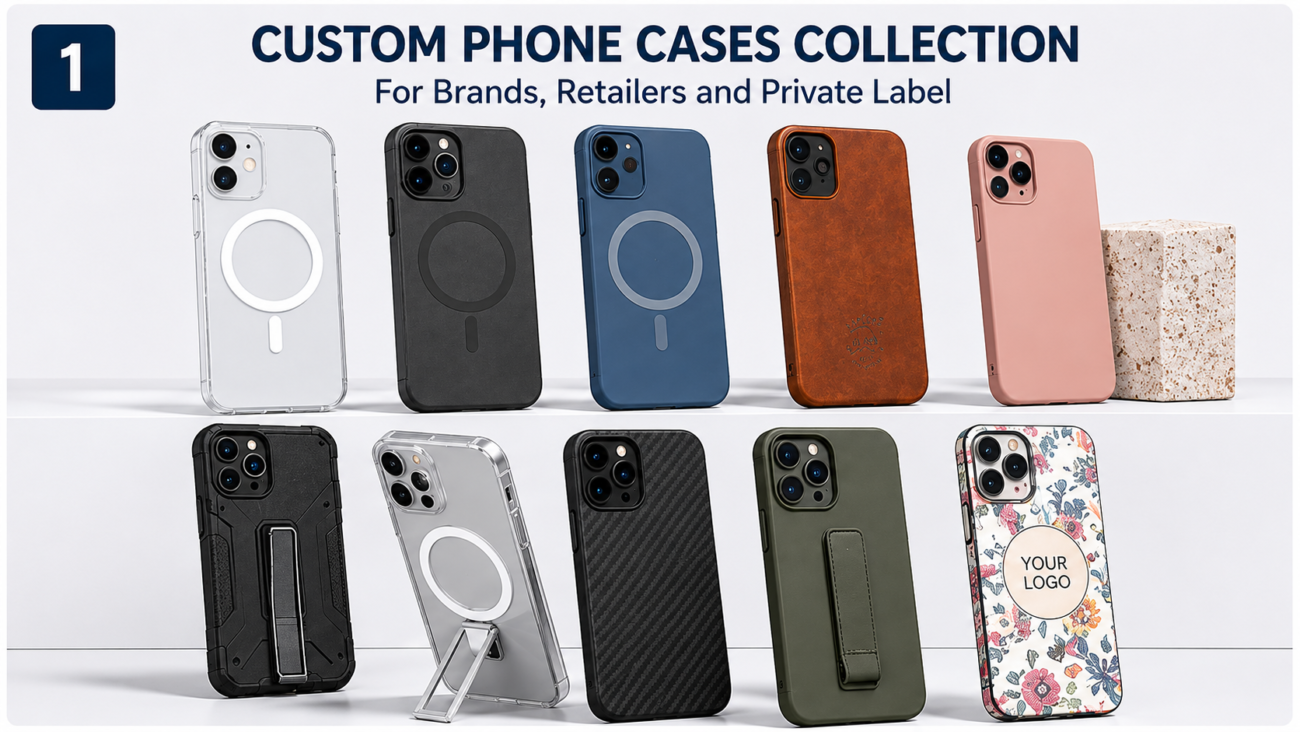
For retail buyers, custom phone cases make it easier to build a more complete category strategy. A retailer may need different product levels, such as basic protection cases, premium leather phone cases, clear cases, magnetic phone cases, and gift-ready packaging. Customization allows each line to serve a different customer group.
For private label buyers, custom phone cases help build long-term brand value. The product is no longer just a phone accessory. It becomes part of the brand’s visual identity and customer experience.
Custom phone cases are especially relevant for:
- E-commerce brands
- Retail chains
- Lifestyle brands
- Promotional product buyers
- Accessory distributors
- Private label businesses
- Corporate gift and campaign buyers
The key advantage is flexibility. Brands can control the look, feel, structure, packaging, and price positioning of the product instead of depending only on ready-made styles.
What Can Be Customized in a Phone Case Project?
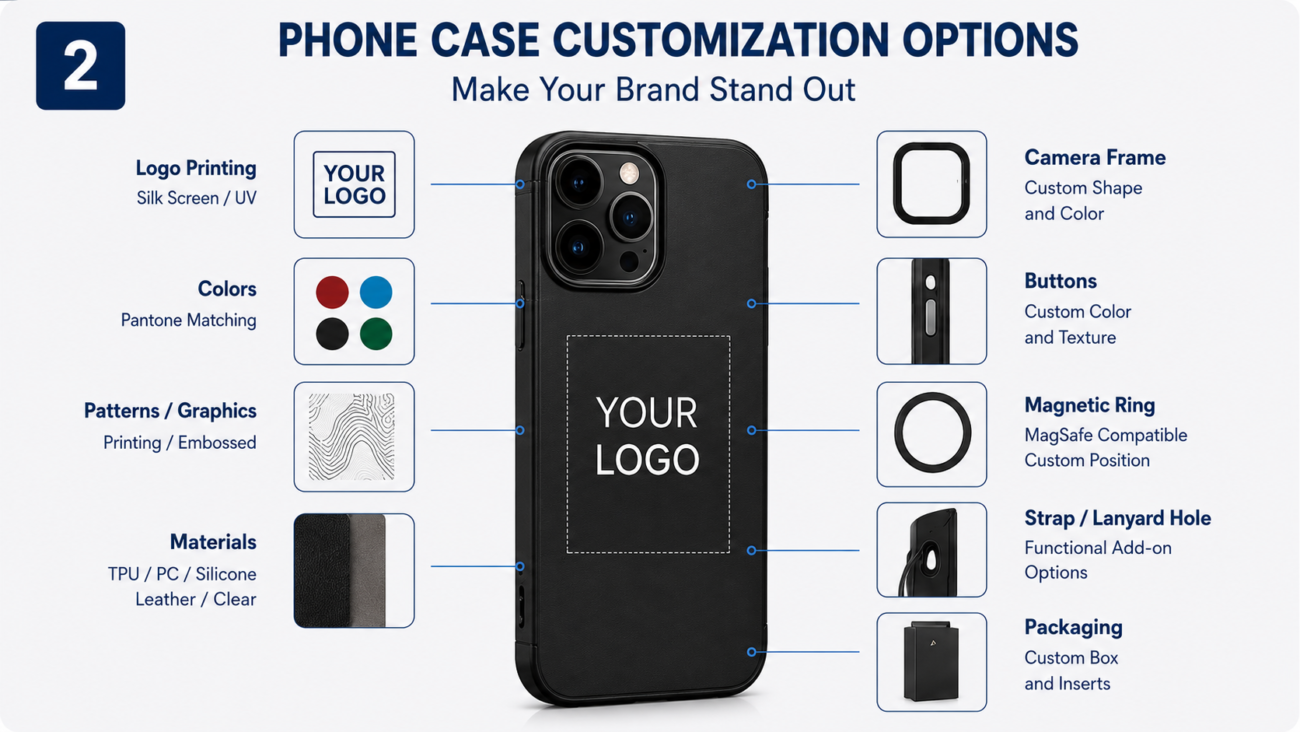
Many buyers think customization only means printing a logo on an existing phone case. In reality, a strong custom phone case project can include much more.
Common customization options include:
- Materials
- Colors
- Surface finish
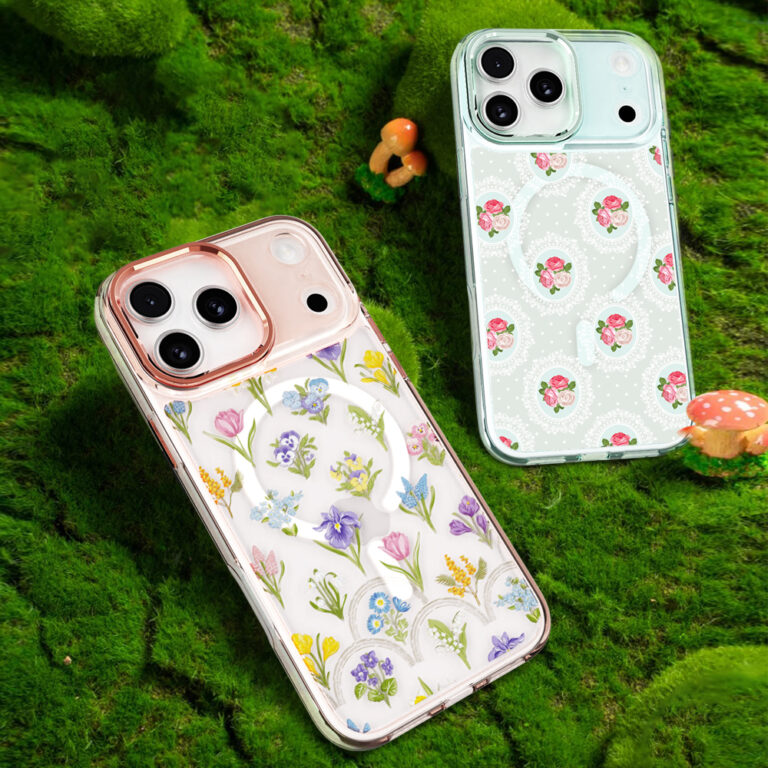
- Graphics and patterns
- Logo placement
- Camera frame design
- Button color and finish
- Magnetic ring structure
- Shockproof corners
- Card holder or strap combinations
- Packaging design
- Retail labels and barcode stickers
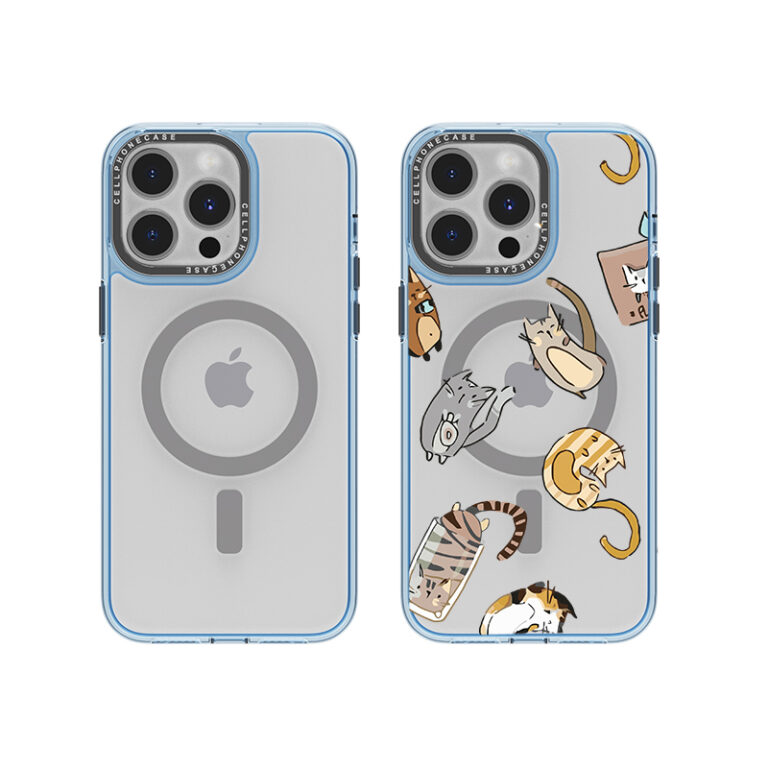
For example, a brand may choose a TPU+PC hybrid structure for better protection, add a magnetic ring for wireless charging compatibility, create a custom color palette, and use printed retail packaging to match its brand style.
Another brand may focus on premium positioning by choosing leather textures, metal button details, and a gift box. A promotional buyer may prefer simple logo printing, lower MOQ, and cost-efficient packaging.
A strong custom phone case project usually combines two layers: product customization and brand presentation. The product needs to look good, function well, and support the brand’s sales strategy.
Custom Phone Case Project Checklist for Buyers
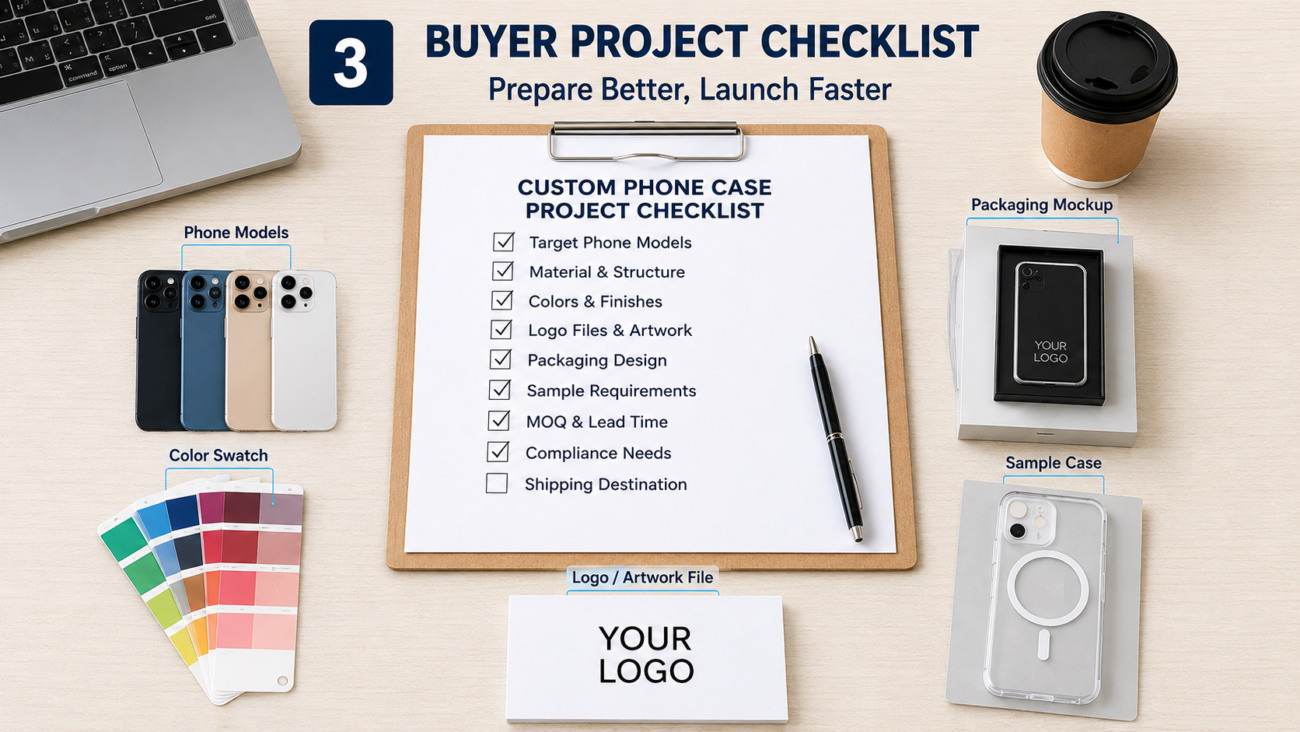
Before starting a custom design phone cover project, buyers should prepare a clear project checklist. This helps the manufacturer understand the project faster and reduces unnecessary revisions during sampling.
| Checklist Item | Why It Matters |
|---|---|
| Target phone models | Different models require different molds, camera openings, button positions, and structure details. |
| Material preference | TPU, PC, silicone, leather, and clear materials support different price points and retail positioning. |
| Product structure | Brands should confirm whether they need slim, shockproof, magnetic, kickstand, wallet, or hybrid structures. |
| Logo method | Printing, embossing, debossing, metal logo plates, or packaging logos can create different brand effects. |
| Color requirements | Custom colors may affect MOQ, sample cost, and production planning. |
| Packaging type | Retail boxes, gift boxes, window boxes, and insert cards should be planned early. |
| MOQ expectation | Bulk custom phone cases usually require clear quantity planning by model, color, and design. |
| Sample deadline | Sampling time should match the brand’s launch calendar. |
| Compliance needs | Buyers should confirm whether RoHS, REACH, or other market requirements are needed. |
| Shipping destination | Final delivery location affects packaging, carton size, labeling, and logistics planning. |
A clear checklist helps both sides avoid misunderstandings and makes the project easier to quote, sample, and produce.
Popular Materials for Custom Phone Cases
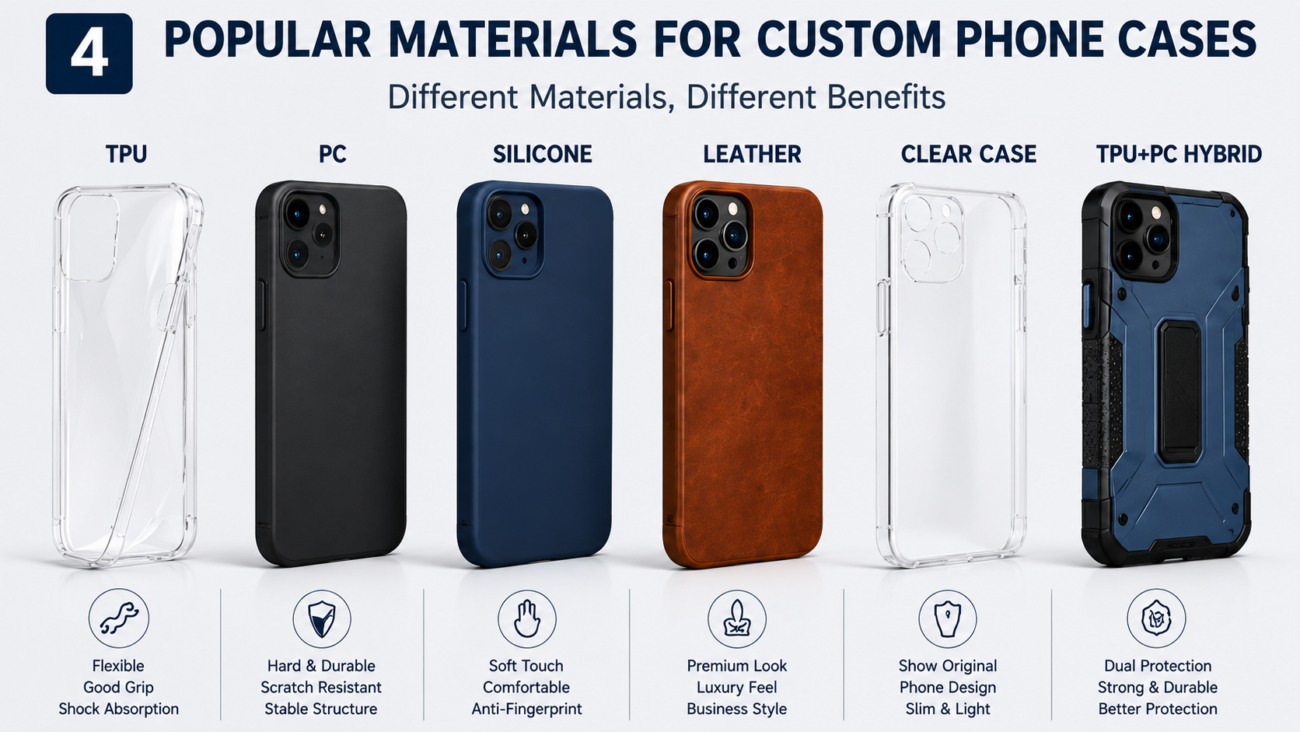
Material selection is one of the most important decisions in any custom phone case project. Different materials support different levels of protection, price points, styles, and customer expectations.
TPU
TPU is widely used for flexible phone cases. It offers good grip, flexibility, and everyday protection. It is suitable for brands that want a practical and affordable product line.
TPU can be used for clear cases, soft protective cases, and hybrid case structures. For basic custom phone cases, TPU is often a cost-effective choice.
PC
PC is a harder material that provides structure and shape stability. It is often used for hard-shell phone cases or as part of a hybrid structure. PC can support printed graphics, transparent designs, and more rigid product forms.
TPU + PC Hybrid
A TPU+PC hybrid phone case combines flexibility and structure. TPU is often used around the edges for shock absorption, while PC is used on the back panel for strength and design presentation.
This structure is popular for brands that want a balance between protection, design, and retail value.
Silicone
Silicone phone cases are known for their soft-touch feel and comfortable grip. They are suitable for lifestyle collections, fashion-oriented product lines, and everyday-use cases.
Silicone can work well for brands that want a clean, minimal, and soft-touch product style.
Leather and Leather-Look Materials
Leather or leather-look phone cases are often used for premium product lines. They can support a more mature, business, or lifestyle-oriented positioning.
These cases may include card slots, wallet functions, or magnetic closure structures depending on the product concept.
Clear Materials
Clear phone cases are useful when brands want to show the phone’s original color or add printed graphics without covering the entire device. Clear materials are also common in custom iPhone cases and fashion-style collections.
Magnetic Structures
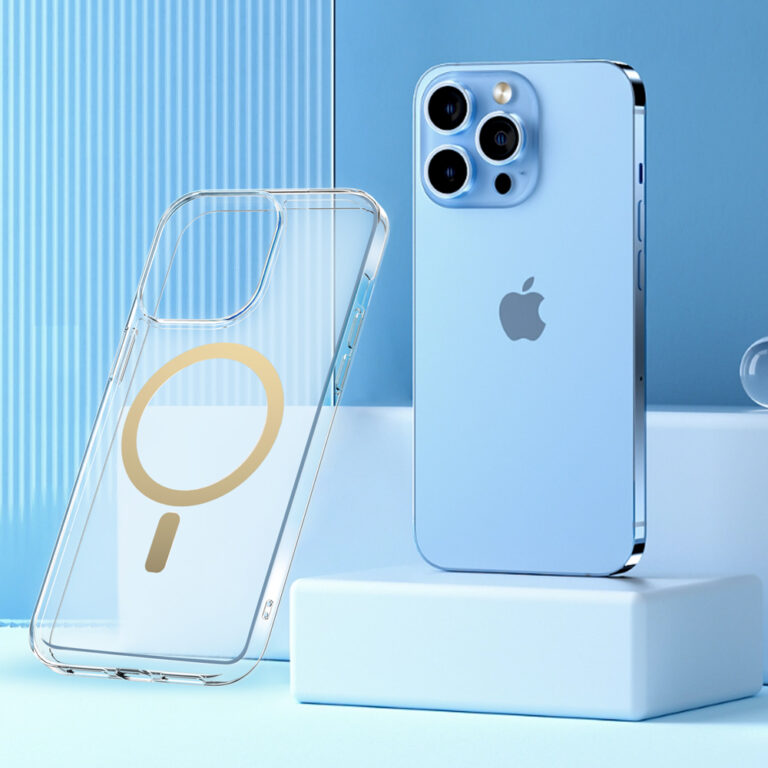
Magnetic phone cases are popular for MagSafe-related accessories and wireless charging compatibility. For this type of product, brands should confirm magnet strength, ring position, charging compatibility, and device model accuracy early in the project.
If your project includes a magnetic phone case, it is important to check the magnetic structure, alignment, and charging performance before mass production. For iPhone-related projects, buyers can also review Apple’s official MagSafe charging guidance when considering magnetic compatibility.
Different materials support different retail strategies. A basic TPU case, a premium leather case, and a magnetic hybrid case may all be custom phone cases, but they serve different customers and price points.
OEM vs ODM for Custom Phone Cases
OEM and ODM are two common development models in custom phone case manufacturing. Understanding the difference can help brands choose the right path.
| Development Model | What It Means | Best For | Advantages |
| OEM | The buyer provides the design, concept, specifications, or brand requirements. The manufacturer produces according to the project requirements. | Brands with clear product ideas, custom structures, or detailed design direction. | More control over product details, branding, and differentiation. |
| ODM | The manufacturer provides existing designs or product structures that the buyer can customize with logo, colors, packaging, or surface changes. | Buyers who want faster launch, lower development risk, or a proven product base. | Faster sampling, shorter development time, and more efficient project planning. |
Not every custom phone case project starts from zero. Many projects begin with an existing structure and then move into deeper customization. For example, a brand may start with an existing magnetic phone case design, then customize the color, logo, packaging, button finish, and accessory bundle.
OEM is usually better when the brand has a clear product vision or wants stronger differentiation. ODM is often better when the buyer wants to launch faster, test the market, or reduce early development costs.
For brands that need flexible OEM/ODM phone case development, the best choice depends on budget, timeline, customization depth, and product goals.
Looking for a Custom Phone Case Manufacturer?
Looking for a custom phone case manufacturer for your next brand, retail, or private label project? Runsuncase supports OEM/ODM development, material selection, logo customization, packaging design, and scalable bulk production.
Request a Quote to discuss your custom phone case project.
Logo, Packaging, and Retail Presentation
A custom phone case project is not complete without packaging and presentation planning. For retail, e-commerce, and private label projects, packaging affects how customers perceive the product before they even touch the case.
Common logo options may include:
- Silk screen printing
- UV printing
- Debossed or embossed logos
- Metal logo plates
- Printed inner lining
- Logo on packaging
- Logo on insert cards
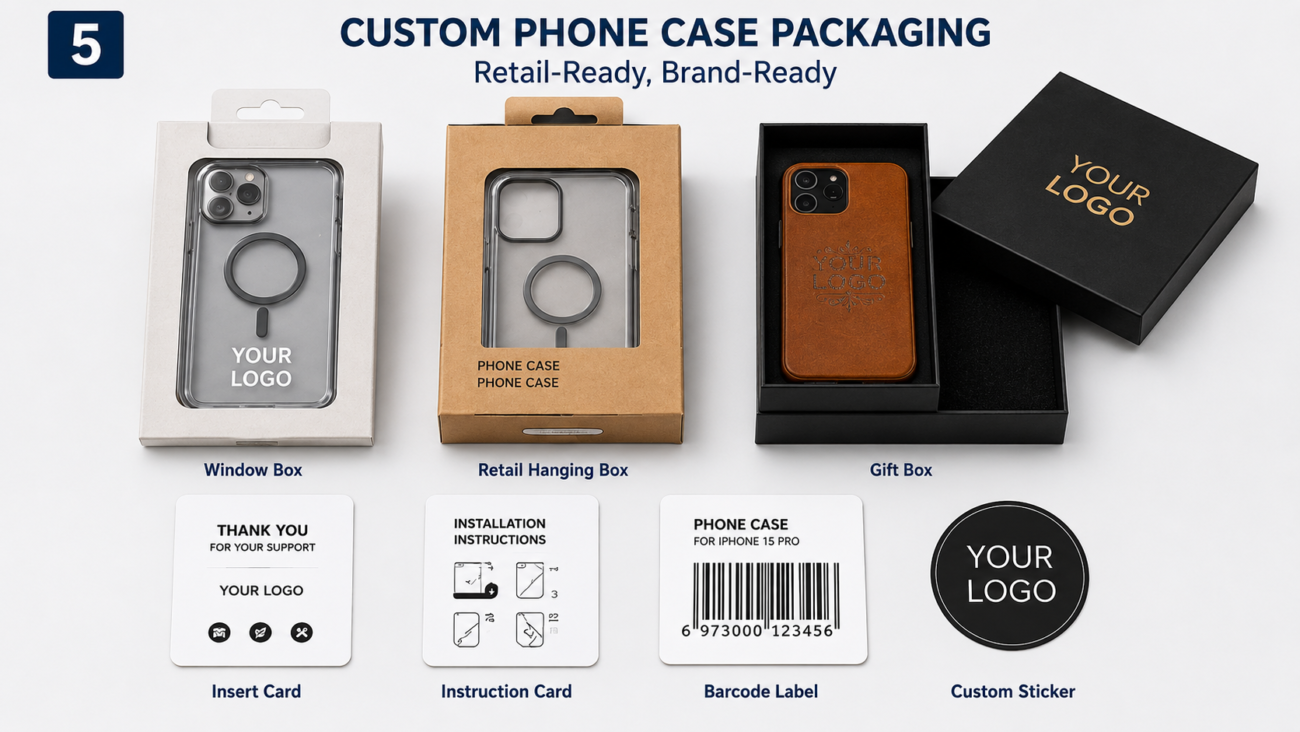
Packaging options may include:
- Simple polybag packaging
- Printed paper box
- Window box
- Gift box
- Retail hanging box
- Insert card
- Barcode label
- Custom sticker
- Product instruction card
For branded phone cases, packaging should match the product positioning. A low-cost promotional case may only need simple packaging. A premium retail collection may need a stronger unboxing experience.
For retail buyers, custom phone case packaging also affects MOQ, cost, production time, storage, barcode planning, and shelf presentation. If the product will be sold through retail chains or online marketplaces, buyers should confirm whether barcode or product identification requirements are needed. GS1 barcode standards are often used by retailers and supply chains for product identification.
Packaging should not be left until the last stage. It should be planned together with the product structure, pricing strategy, and launch schedule.
MOQ, Sampling, and Production Planning
MOQ and sampling are key parts of custom phone case development. The required MOQ can vary depending on the material, phone model, color, mold, printing method, packaging type, and customization level.
Simple logo customization on an existing case may require a lower MOQ than a fully custom structure. Custom colors, special materials, magnetic components, and custom phone case packaging may increase the MOQ.
For buyers sourcing bulk custom phone cases, early quantity planning is essential. Brands should confirm how many phone models, colors, and designs they want to launch in the first batch. Without clear quantity planning, it is difficult to estimate cost, sample direction, production lead time, and packaging requirements.
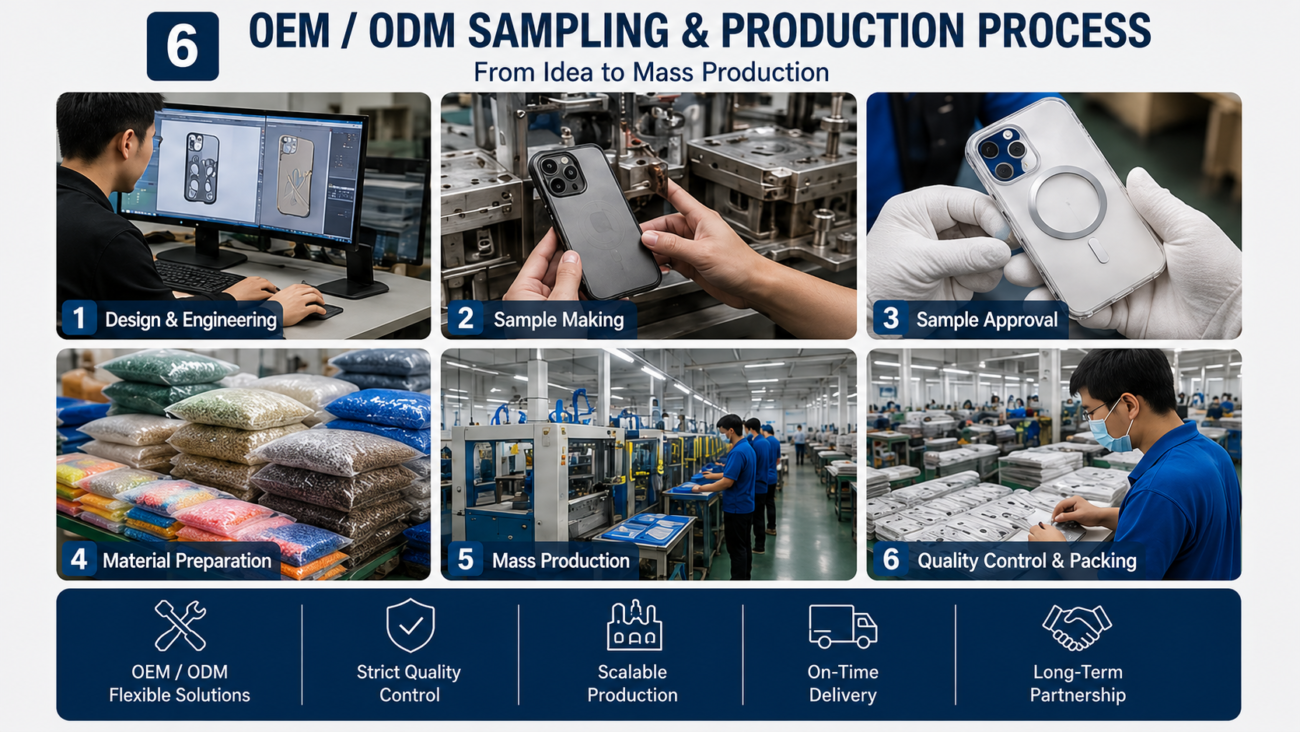
Brands should also consider sample timelines. A simple sample may be faster to prepare, while a more complex project may require material confirmation, artwork adjustment, tooling review, color matching, and packaging mockups.
Common planning points include:
- Confirm target phone models early
- Confirm material and structure before artwork
- Decide logo method before sampling
- Confirm packaging requirements early
- Review sample quality carefully
- Test magnetic or wireless charging functions if needed
- Plan around launch dates and retail delivery schedules
Clear MOQ and sample planning can reduce project delays and avoid unrealistic expectations. For retail launches, seasonal collections, or e-commerce campaigns, buyers should leave enough time for sampling, revisions, packaging production, mass production, inspection, and shipment.
How to Choose a Custom Phone Case Manufacturer
Choosing a custom phone case manufacturer is not only about finding the lowest price. It is about finding a partner who can support product execution from concept to delivery.
A good manufacturer should understand materials, structures, model compatibility, packaging, and production planning. The supplier should also be able to communicate clearly during sampling and mass production.
When evaluating a manufacturer, brands should check:
- Material knowledge
- OEM/ODM flexibility
- Experience with multiple phone case structures
- Sampling speed
- Packaging support
- Quality control process
- Communication efficiency
- Production capacity
- Ability to scale with the brand
- Experience with retail or private label projects
For B2B buyers, communication is especially important. Custom phone case projects often involve design files, sample revisions, packaging details, color matching, and shipment planning. A manufacturer with weak project management can cause delays even when the product itself is simple.
Quality control should also be reviewed before confirming a supplier. Buyers should ask how the factory checks materials, case fit, buttons, camera openings, surface finish, packaging, and final shipment quality.
For international retail and distribution projects, compliance may also be part of supplier evaluation. Depending on the target market and product structure, buyers may need to consider RoHS, REACH, material reports, packaging requirements, or social compliance programs such as amfori BSCI.
The best supplier is not always the cheapest one. The better choice is usually the manufacturer that can help the brand reduce risk, improve execution, and support long-term growth.
Custom Phone Cases for Retail, E-commerce, and Private Label Projects
Different buyer types have different needs.
Retail buyers usually care about category fit, packaging quality, stable replenishment, and product consistency. They need products that look good on shelves, meet customer expectations, and can be reordered reliably.
E-commerce brands often focus on differentiation, product imagery, customer reviews, and manageable MOQ. They need custom phone cases that look strong in photos and offer clear selling points online.
Private label buyers need brand consistency and supplier flexibility. They may need customized logo placement, packaging design, product bundles, and multiple SKUs across different phone models.
Accessory distributors often need a broader product range. They may focus on competitive pricing, stable supply, and the ability to serve different market segments.
This is why custom phone cases should be developed around the sales channel. A product designed for Amazon, a retail chain, and a premium lifestyle store may require different materials, packaging, and price strategies.
Common Mistakes Brands Make in Custom Phone Case Projects
Custom phone case projects can be very successful, but many buyers make avoidable mistakes during development.
Focusing Only on Price
Low price is important, but it should not be the only decision factor. A very low-cost product may create problems with material quality, fit, packaging, or long-term customer satisfaction.
Ignoring Packaging Until the Last Stage
Packaging should be considered early. It affects branding, MOQ, production time, shipping volume, and retail presentation.
Not Confirming Material Limitations
Every material has advantages and limitations. Buyers should confirm what can be printed, molded, colored, or combined before finalizing the design.
Unclear MOQ Expectations
MOQ should be discussed early, especially for custom colors, private label phone cases, and custom phone case packaging.
Weak Sample Review Process
Samples should be reviewed carefully for fit, color, logo position, button feel, camera cutout, packaging, and functional details.
Not Checking Magnetic or Wireless Charging Compatibility
For magnetic phone cases, buyers should confirm magnet position, strength, and wireless charging compatibility before mass production.
Choosing a Supplier With Poor Communication
Even a simple custom phone case project needs clear communication. A responsive manufacturer can help solve problems earlier and reduce project delays.
FAQ
What are custom phone cases for brands?
Custom phone cases for brands are phone cases developed with specific brand requirements, such as custom materials, colors, logo placement, packaging, graphics, structures, or accessory combinations. They are commonly used by retailers, e-commerce brands, distributors, and private label buyers.
What can be customized in a phone case project?
A phone case project can include customized materials, colors, surface finishes, printed patterns, logo methods, button details, camera frame design, magnetic structures, packaging, labels, and accessory bundles such as straps or card holders.
What is the difference between OEM and ODM custom phone cases?
OEM custom phone cases are usually produced based on the buyer’s design, specifications, or product concept. ODM custom phone cases are based on existing manufacturer designs that can be customized with branding, colors, packaging, or other changes.
What is the MOQ for custom phone cases?
The MOQ for custom phone cases depends on the material, model, color, logo method, packaging type, and customization depth. Simple logo customization on an existing structure may have a different MOQ from a fully custom mold, custom color, or retail packaging project.
How long does it take to produce custom phone cases?
Production time depends on the project complexity. Buyers should consider sampling, sample revisions, packaging confirmation, material preparation, mass production, quality inspection, and shipment planning. For retail or seasonal launches, it is better to start the project early.
What should brands check before choosing a custom phone case manufacturer?
Brands should check the manufacturer’s material knowledge, OEM/ODM capabilities, sampling speed, packaging support, quality control, communication, production capacity, and ability to support future scaling.
Are custom phone cases suitable for retail and private label projects?
Yes. Custom phone cases are suitable for retail, e-commerce, distributors, and private label projects because they allow brands to control product design, packaging, positioning, and customer experience.
Ready to Start a Custom Phone Case Project?
If you are planning a custom phone case line for retail, e-commerce, or private label business, Runsuncase can support your project from design direction and sampling to packaging and mass production.
Whether you need OEM/ODM phone case development, private label phone cases, custom phone case packaging, or scalable production support, working with the right manufacturer can help turn your idea into a market-ready product.
Talk to Our Team to discuss your next custom phone case project.