Introduction
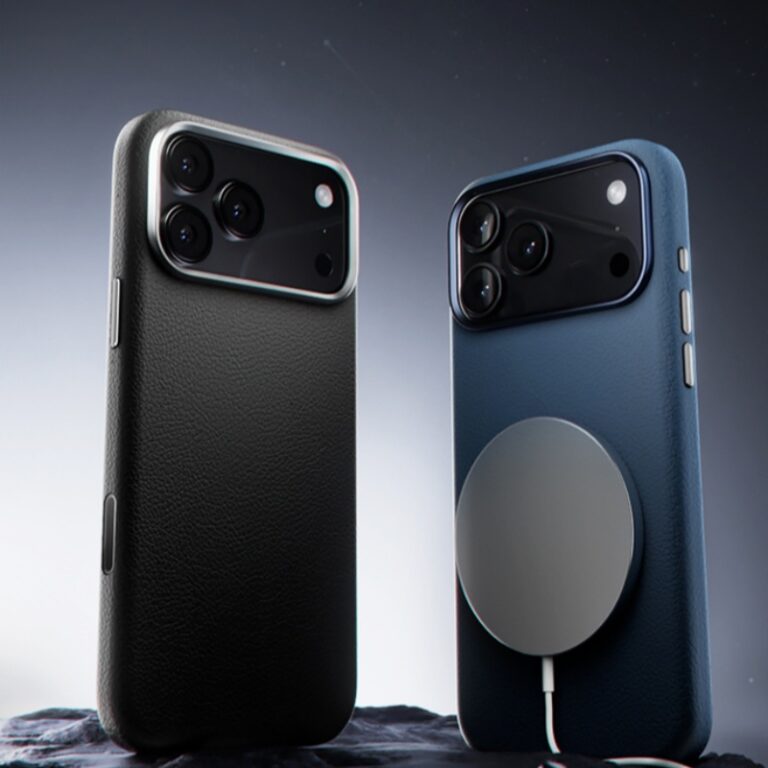
Choosing the right iPhone case manufacturer is an important decision for brands, retailers, distributors, and private label buyers. iPhone cases remain one of the most competitive and commercially valuable categories in the mobile accessories market. Every new iPhone release creates fresh demand for updated case models, new colors, improved materials, MagSafe-compatible structures, and retail-ready packaging.
For B2B buyers, sourcing iPhone cases is not only about finding a low unit price. A reliable manufacturing partner should help with product development, material selection, mold accuracy, MagSafe performance, packaging design, quality control, and scalable production. These factors directly affect launch timing, customer reviews, retail presentation, and repeat order stability.
The iPhone case market is also moving faster than before. Buyers need to prepare multiple models, support different sales channels, and respond quickly to new design trends. Whether you are building a custom iPhone case collection, planning wholesale iPhone cases, or developing private label iPhone cases, the manufacturer you choose can strongly influence the success of your project.
This guide explains what an experienced iPhone case manufacturer should offer, how to compare OEM and ODM options, what materials and structures matter, and how to plan MOQ, sampling, packaging, and production more effectively.
Why iPhone Cases Are Still a Core Product Category
iPhone cases continue to be a core product category because demand is stable, repeatable, and closely tied to annual iPhone model updates. Each new iPhone generation brings changes in size, camera layout, button position, and protection requirements. This creates recurring opportunities for brands and retailers to launch updated collections.
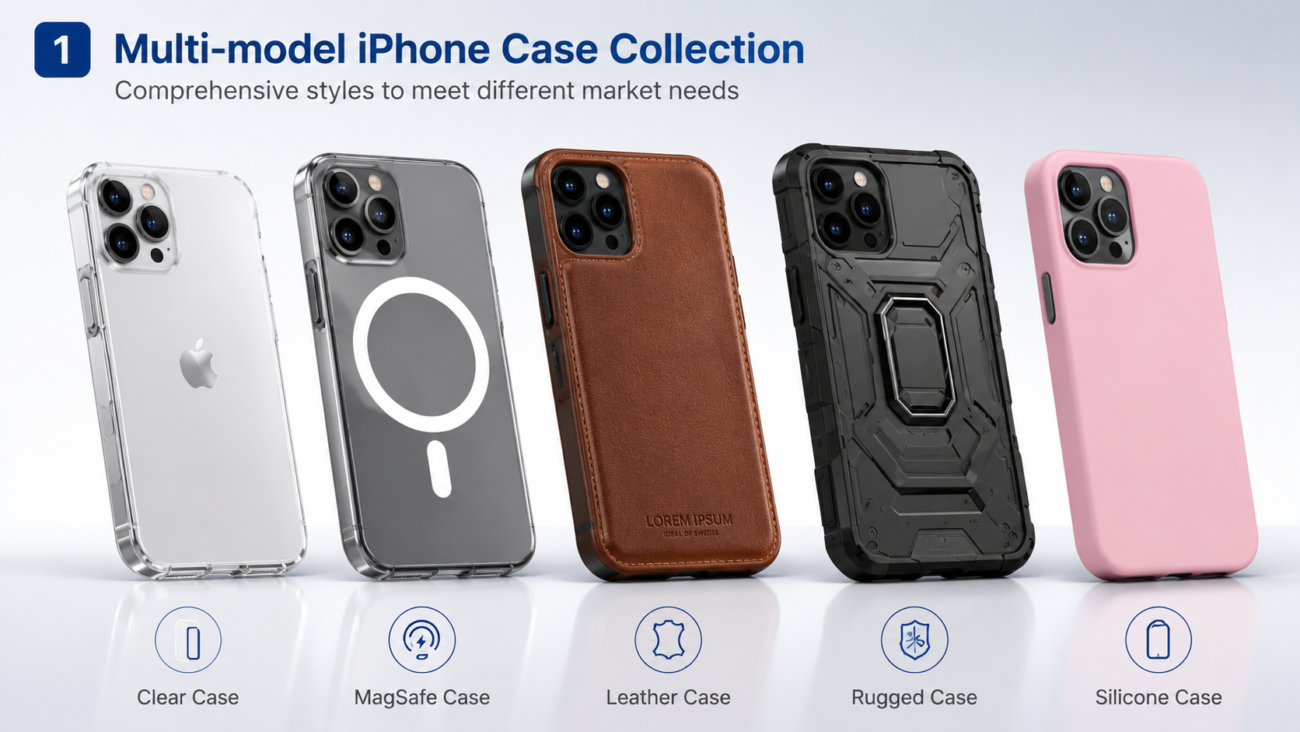
For many accessory brands, iPhone cases are not just single products. They are the foundation of a broader product line. A brand may start with clear cases or MagSafe-compatible phone cases, then expand into leather cases, rugged cases, wallet cases, AirPods cases, screen protectors, straps, and packaging bundles.
The category also supports different price points. Entry-level cases work well for wholesale and promotional channels, while premium materials, branded packaging, MagSafe compatibility, and fashion-focused designs can support higher margins.
For distributors and retail buyers, iPhone cases are easy to segment by customer type. A minimalist clear case may suit everyday users. A rugged case may appeal to outdoor or workwear customers. A leather case may fit business users. A fashion case may work better for lifestyle and gift channels.
This flexibility makes iPhone cases one of the most important categories for mobile accessory sourcing.
What an iPhone Case Manufacturer Should Be Able to Offer
A qualified iPhone case manufacturer should do more than produce basic phone cases. The right partner should understand how brands plan collections, how retail channels evaluate packaging, and how product structure affects the user experience.
A reliable manufacturer should be able to support OEM/ODM phone case development, custom colors, private label packaging, MagSafe-compatible structures, and scalable production.
A qualified manufacturer should be able to support:
- Multiple iPhone models across different generations
- Accurate camera, button, speaker, and charging port cutouts
- Consistent fit across production batches
- TPU, PC, silicone, leather, hybrid, and clear material options
- Anti-yellowing clear case materials
- MagSafe-compatible structures
- OEM and ODM phone case development
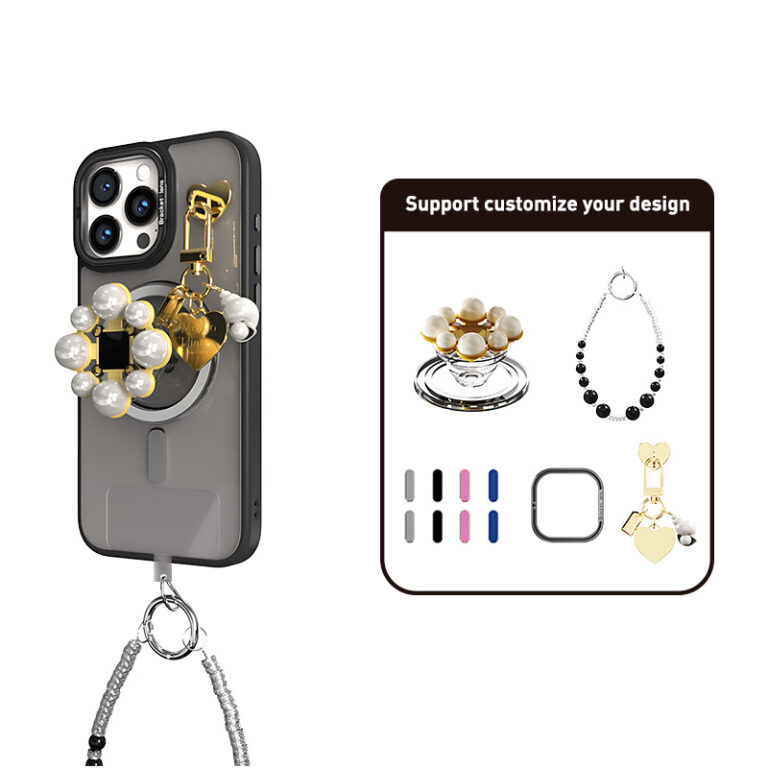
- Custom colors, textures, prints, logos, and finishes
- Private label iPhone cases
- Custom iPhone case packaging
- Sampling before mass production
- Quality inspection and repeat order support
Accuracy is especially important for iPhone case manufacturing. Small issues with camera protection height, button sensitivity, magnetic ring alignment, or case thickness can create customer complaints. For B2B buyers, these problems may lead to returns, poor reviews, delayed launches, and damaged brand trust.
A strong iPhone case factory should also help buyers plan ahead. If you are preparing for a new iPhone launch, timing matters. The manufacturer should be able to support sample review, packaging confirmation, production scheduling, inspection, and shipping coordination.
For brands looking for a long-term phone case manufacturer, production capability and project communication are equally important.
Popular Types of iPhone Cases for Brands and Retailers
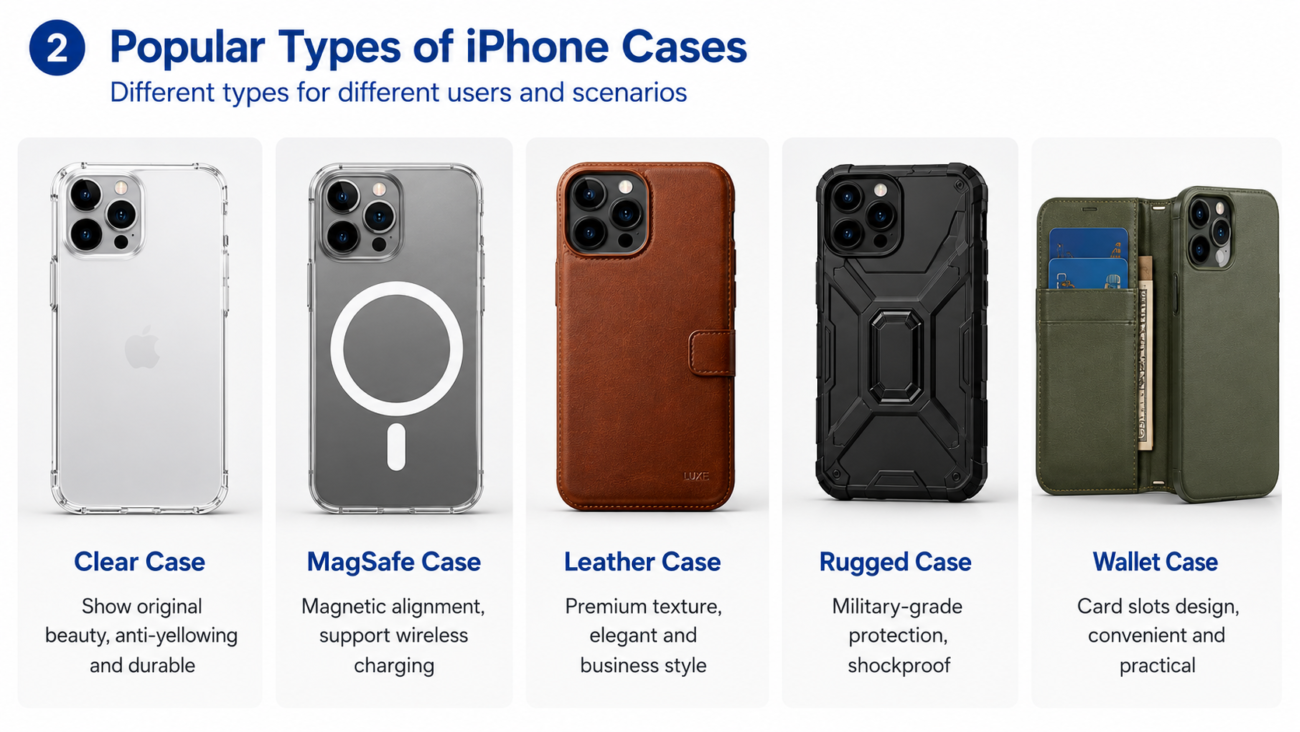
Different iPhone case types serve different customers, price levels, and sales channels. Buyers planning wholesale iPhone cases should compare materials, structure, packaging, and repeat order stability before confirming a supplier.
Clear iPhone Cases
Clear iPhone cases are popular because they show the original iPhone design while offering daily protection. For brands, the key points are anti-yellowing performance, scratch resistance, edge protection, transparency, and long-term durability.
TPU / PC Hybrid iPhone Cases
TPU and PC hybrid cases combine flexible edges with a harder back structure. TPU helps absorb shock, while PC provides shape and rigidity. This structure is widely used for protective and mid-range iPhone case lines.
Leather iPhone Cases
Leather iPhone cases are suitable for premium collections, business users, gifting, and lifestyle retail. Buyers should focus on leather texture, stitching, edge finishing, color consistency, and packaging presentation.
Magnetic / MagSafe-Compatible iPhone Cases
MagSafe-compatible iPhone cases are now important for many mid-range and premium product lines. These cases include magnetic ring structures that support magnetic chargers, wallets, stands, car mounts, and other accessories. Buyers can review products such as a Clear Magnetic Phone Case to understand how magnetic structures are commonly applied in commercial case designs.
Wallet or Card Holder iPhone Cases
Wallet iPhone cases combine protection with storage. They are suitable for travel, lifestyle, and business customers. Brands can develop card slots, folio structures, magnetic closures, detachable wallets, or kickstand designs.
Rugged Protective iPhone Cases
Rugged cases are designed for stronger protection. They may include reinforced corners, raised bezels, shock-absorbing layers, air-cushion structures, or multi-layer designs. These products fit outdoor, industrial, workwear, and heavy-duty markets.
Fashion-Focused or Branded iPhone Cases
Fashion iPhone cases focus on color, graphics, texture, logo, and brand identity. They are suitable for DTC brands, boutiques, lifestyle retailers, and seasonal collections. For this category, surface finishing and packaging are especially important.
Wholesale and Private Label iPhone Case Projects
For wholesale and private label buyers, iPhone case sourcing is usually not limited to one model or one design. Buyers often need a complete product line that covers multiple iPhone versions, colors, packaging styles, and customer groups.
A reliable iPhone case supplier should help buyers build a collection that is easy to sell, easy to restock, and easy to expand. This may include standard wholesale iPhone cases, custom iPhone cases with brand logos, private label packaging, barcode labels, and retail-ready bundles.
Wholesale buyers usually care about stable pricing, repeat order consistency, and delivery reliability. Private label buyers care more about branding, packaging, differentiation, and product presentation. A strong manufacturer should be able to support both types of projects.
For example, a retailer may need a clear case series, a MagSafe-compatible series, and a rugged protection series. A DTC brand may need custom colors, unique textures, branded packaging, and insert cards. A distributor may need model labels, barcode stickers, and packaging consistency across different iPhone versions.
This is why choosing an experienced iPhone case manufacturer is more valuable than choosing a supplier based only on price.
Materials and Structure Considerations
Material choice affects product quality, protection level, appearance, cost, and brand positioning. A professional iPhone case manufacturer should help buyers choose the right material based on their target market and sales channel.
TPU is flexible, lightweight, and commonly used for shock-absorbing edges. It is suitable for soft cases, clear cases, and protective structures. Buyers should evaluate flexibility, surface feel, transparency, and yellowing resistance.
PC is harder and provides stronger structure. It is commonly used for backplates, hard shells, and hybrid designs. PC can support glossy finishes, matte finishes, printing, transparent effects, and stronger shape stability.
TPU+PC hybrid structures are popular because they balance flexibility and rigidity. This structure is suitable for brands that want better protection without making the case too bulky.
Silicone is often used for soft-touch cases. It provides good grip and a smooth hand feel. Buyers should check dust resistance, coating quality, color consistency, and surface durability.
Leather and leather-like materials are suitable for premium collections. These materials create a more refined look and can work well with business, gifting, and lifestyle positioning.
For clear iPhone cases, anti-yellowing material is especially important. Buyers should confirm material quality, coating options, and testing standards before mass production.
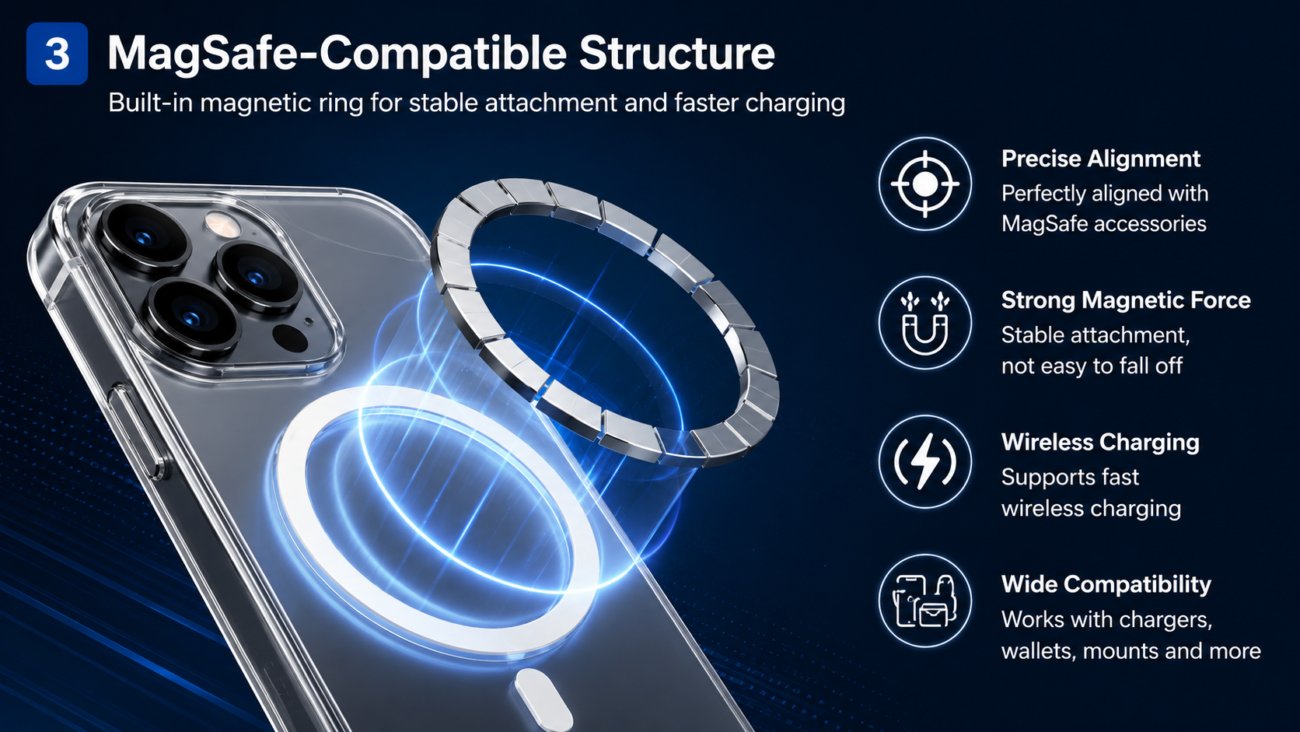
For MagSafe-compatible iPhone cases, the magnetic ring must be integrated correctly. Magnet strength, ring position, backplate structure, and case thickness all affect product performance.
MagSafe Compatibility and Functional Features
MagSafe compatibility is a key consideration for many iPhone case projects. Apple explains that MagSafe wireless charging uses magnetic alignment to support wireless charging on supported iPhone models. For case buyers, this means the case structure must be planned carefully around magnet placement, material thickness, and charging performance.
A MagSafe-compatible phone case should not simply have a printed ring on the back. The structure should include a properly positioned magnetic ring that supports stable attachment and charging alignment.
For brands, this is important because customers often use magnetic chargers, wallets, stands, power banks, grips, and car mounts. If the magnetic structure is weak or misaligned, the user experience can be poor.
A professional MagSafe iPhone case manufacturer should evaluate:
- Magnetic ring alignment
- Magnet pull force
- Charging alignment
- Wireless charging performance
- Case thickness
- Heat performance during charging
- Accessory attachment stability
- Durability after repeated use
Wireless charging standards are also continuing to evolve. The Wireless Power Consortium highlights Qi and Qi2 as important wireless charging standards, which makes compatibility and testing more important for brands planning magnetic iPhone accessories.
Buyers should also be careful with product claims. Unless the product has the proper authorization, it is safer to use terms such as “MagSafe-compatible” instead of making unsupported certification claims.
Functional features can also help brands create more differentiated products. Popular options include kickstands, card holders, camera lens protection, wrist straps, crossbody straps, magnetic wallets, textured grips, and reinforced corners.
For mid-range and premium iPhone case collections, MagSafe compatibility is no longer just an extra feature. It has become an important part of product planning.
OEM vs ODM for iPhone Case Projects
When working with an iPhone case manufacturer, buyers usually choose between OEM, ODM, or a mixed development approach.
| Development Type | Best For | Advantages | Considerations |
|---|---|---|---|
| OEM iPhone Cases | Brands with unique designs or special product requirements | Strong customization, stronger brand identity, more control over structure and details | Longer development time, higher mold or sampling cost |
| ODM iPhone Cases | Buyers who need faster launch with existing proven structures | Faster sampling, lower development risk, more efficient production planning | Less structural uniqueness compared with full OEM |
| Mixed Approach | Buyers who need speed but still want moderate customization | Good balance of launch speed and brand differentiation | Customization depends on existing mold and structure |
OEM is suitable for brands that already have a clear design direction. If you are comparing an OEM phone case manufacturer, the key is whether the supplier can support sampling, structure development, packaging, and stable production.
ODM is suitable for buyers who want to launch faster using proven models, then customize colors, logos, packaging, surface finishes, or MagSafe options.
Many B2B buyers choose a mixed approach. They start with an existing case structure and customize the parts that matter most to their brand. This can reduce development time while still creating a customized product line.
For buyers comparing an OEM iPhone case manufacturer, the key is not only whether the factory can make the product, but whether it can help manage the full development process from sampling to mass production.
MOQ, Sampling, and Launch Planning
MOQ, sampling, and production planning should be discussed early in the project. These factors affect cost, launch timing, inventory planning, and packaging preparation.
MOQ can vary depending on material, color, logo method, packaging type, mold requirements, and customization level. A standard wholesale case may have a lower MOQ, while custom colors, private label packaging, special finishes, or new molds may require a higher quantity.
Before mass production, buyers should review samples carefully. Important sample review points include:
- Case fit
- Button response
- Camera protection
- Port and speaker cutouts
- Material texture
- Color accuracy
- Logo position
- MagSafe performance
- Packaging structure
- Barcode and labeling details
Production lead time should also be planned around the sales calendar. This is especially important when launching products for a new iPhone release. Buyers may need to prepare multiple models at the same time, including standard, Plus, Pro, and Pro Max versions.
If your brand is preparing around future model launches, this guide on what phone case brands can do before the iPhone 17 launch can help you think about model planning, sampling, and launch timing more clearly.
A strong iPhone case manufacturer should help buyers coordinate sample approval, packaging confirmation, mass production, quality inspection, and shipping.
The best manufacturer does not only provide capacity. It helps buyers reduce sourcing risk and launch products on time.
Packaging and Retail Presentation
Packaging plays a major role in iPhone accessory sales. It affects product value, customer trust, retail shelf impact, and brand perception.
For retail channels, packaging should display the product clearly and communicate quality. For e-commerce channels, packaging should balance presentation, protection, shipping efficiency, and cost control.
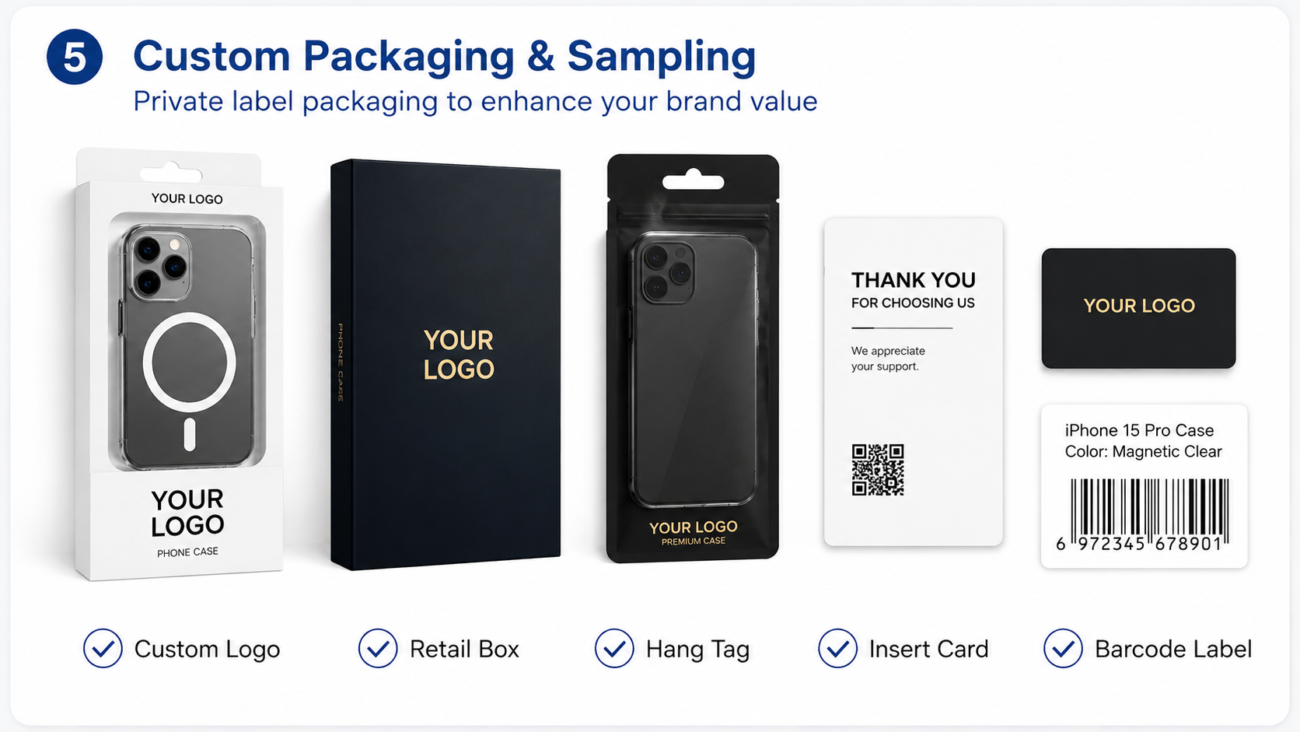
Custom iPhone case packaging may include:
- Branded paper boxes
- Retail hanging boxes
- PET window boxes
- Insert cards
- Instruction cards
- Barcode labels
- Model stickers
- Anti-scratch films
- Eco-friendly packaging options
Private label iPhone cases should maintain a consistent brand system across the full product line. Logo placement, color style, product naming, model labels, and barcode layout should be planned before production.
Packaging should not be treated as a final detail. For brands, retailers, and distributors, it can directly affect perceived value and sales performance.
How to Choose the Right iPhone Case Manufacturer
Choosing the right iPhone case manufacturer can reduce sourcing risk. Buyers can also use a phone case factory audit checklist to review production capability, quality control, communication, and repeat order stability.
Buyers should evaluate both manufacturing ability and project support.
Use this supplier evaluation checklist:
- Does the manufacturer have experience with iPhone case production?
- Can they support multiple iPhone models?
- Do they understand MagSafe-compatible structures?
- Can they provide different materials and finishes?
- Are the cutouts, buttons, and camera protection accurate?
- Can they support OEM and ODM development?
- Do they provide samples before mass production?
- Can they support custom iPhone case packaging?
- Do they understand retail and e-commerce requirements?
- Can they support private label iPhone cases?
- Do they have stable production capacity for repeat orders?
- Is communication fast, clear, and professional?
The best manufacturer is not always the cheapest supplier. A low unit price can become expensive if the supplier causes delays, quality problems, packaging issues, poor fit, or unstable repeat orders.
For serious buyers, supplier selection should focus on long-term reliability. A strong manufacturing partner should help brands control product quality, launch on time, and maintain consistency across different models and production batches.
Why Manufacturing Experience Matters
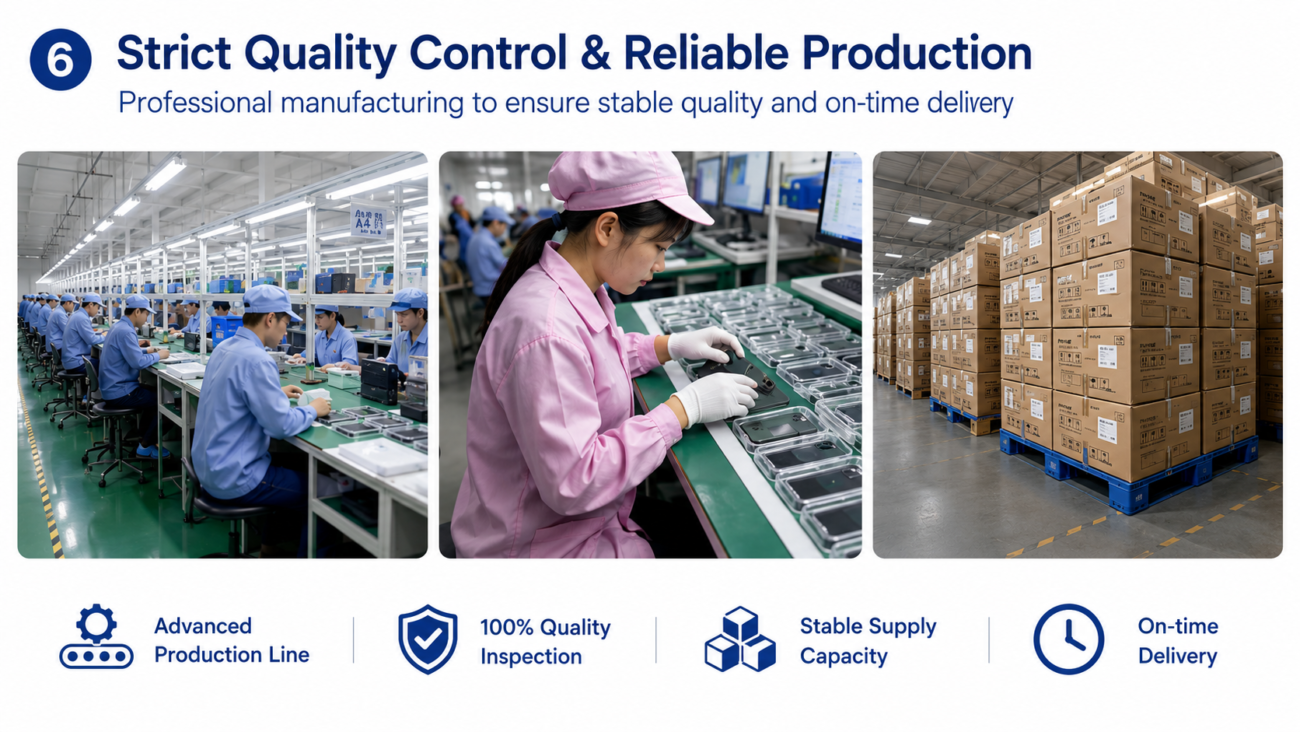
Manufacturing experience directly affects fit accuracy, material consistency, MagSafe alignment, packaging execution, and repeat order stability. iPhone case projects require precise structure control because every model has different dimensions, button positions, camera designs, and protection requirements.
Experienced manufacturers understand how to manage mold accuracy, material selection, surface finishing, printing, logo placement, magnetic structures, and packaging requirements. This helps buyers avoid common problems during sampling and mass production.
Runsuncase supports OEM/ODM phone case development for brands, retailers, distributors, and private label projects. From material selection and sampling to MagSafe-compatible structures, custom packaging, and scalable production, Runsuncase helps buyers develop iPhone case collections that are built for real commercial use.
Common Mistakes Buyers Make When Sourcing iPhone Cases
Many sourcing problems happen because buyers focus too much on price and not enough on product execution.
One common mistake is choosing a supplier only by unit cost. Price matters, but low-cost production can create bigger problems if materials, fit, packaging, or quality control are weak.
Another mistake is ignoring fit precision. iPhone cases must match camera modules, buttons, charging ports, speakers, and screen edges accurately. Poor fit can quickly lead to returns and negative customer feedback.
Some buyers also overlook MagSafe performance. A case may look magnetic, but if the ring alignment or magnet strength is poor, the product may not perform well with chargers or accessories.
Packaging is another area that is often confirmed too late. Buyers should finalize packaging size, box structure, labels, barcode requirements, and branding details before mass production.
Weak sample review is also risky. Buyers should test samples carefully before confirming production, especially for new materials, custom colors, MagSafe-compatible cases, and private label packaging.
Finally, unclear model planning can create inventory problems. Brands should decide which iPhone models to support based on target market, channel demand, and launch timing.
Need an OEM/ODM iPhone Case Manufacturer?
Share your target iPhone models, material preference, estimated quantity, logo requirements, packaging needs, and launch timeline. Runsuncase can help you review the best production solution for your project.
FAQ
What should buyers look for in an iPhone case manufacturer?
Buyers should look for iPhone case production experience, accurate fit, stable quality, material options, MagSafe-compatible structures, sampling support, custom packaging capability, and reliable communication. A good manufacturer should support both production and project planning.
What types of iPhone cases are most popular for retail and e-commerce?
Popular types include clear iPhone cases, TPU/PC hybrid cases, leather cases, MagSafe-compatible cases, wallet cases, rugged protective cases, and fashion-focused branded cases. The best choice depends on customer group, sales channel, and price point.
How important is MagSafe compatibility for iPhone case projects?
MagSafe compatibility is very important for many mid-range and premium iPhone case lines. It supports magnetic charging alignment and accessory attachment, including wallets, stands, mounts, grips, and power banks. Buyers should confirm ring alignment, magnet strength, and charging performance during sampling.
What is the difference between OEM and ODM iPhone case manufacturing?
OEM manufacturing is suitable for buyers with specific designs, structures, or brand requirements. ODM manufacturing uses existing proven structures for faster launch. Many buyers use a mixed approach by starting with an ODM structure and customizing colors, logos, materials, packaging, or MagSafe features.
How do brands plan MOQ and packaging for custom iPhone cases?
Brands should confirm MOQ based on material, color, customization level, logo method, packaging, and model quantity. Packaging should be planned early, including box type, logo design, barcode labels, insert cards, model stickers, and retail or e-commerce requirements.
Can I customize iPhone cases with my brand logo and packaging?
Yes. Brands can usually customize logo placement, colors, surface finishes, materials, packaging boxes, insert cards, barcode labels, and model stickers. For private label iPhone cases, it is best to confirm branding and packaging requirements before sampling.
What information should I prepare before contacting an iPhone case manufacturer?
Buyers should prepare target iPhone models, case type, material preference, estimated order quantity, logo requirements, packaging needs, sales channel, target market, and expected launch date. Clear project information helps the manufacturer provide faster and more accurate recommendations.
Final CTA
Plan your next iPhone case collection with Runsuncase.
From MagSafe-compatible structures and material selection to private label packaging and mass production, Runsuncase supports brands, retailers, and distributors with scalable iPhone case manufacturing solutions.
Whether you need custom iPhone cases, wholesale iPhone cases, OEM/ODM development, or private label packaging, our team can help you move from idea to production with better speed, quality, and execution.