
Before a new phone is public, treat phone case fit as provisional. You can’t confirm fit until you have confirmed geometry for the final device. To protect the launch, keep verified dimensions separate from estimates. Hold off on tooling and production approvals you can’t easily undo, and decide ahead of time what you’ll do if the model changes.
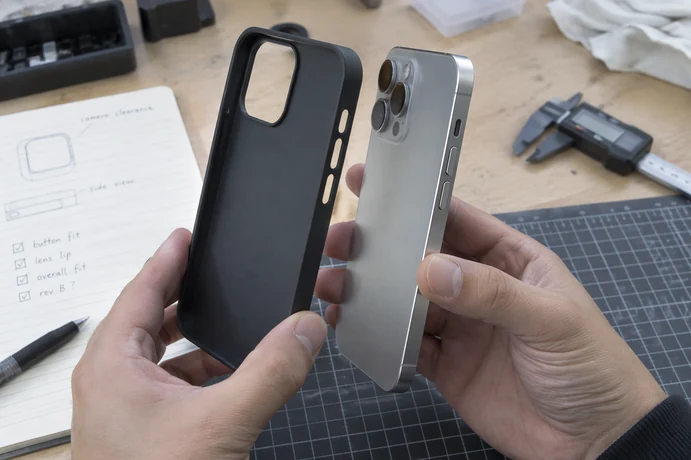
In practice, every dimension needs a known source and a confidence label. Each check you run proves only what that evidence can support. Any early commitment also needs a written plan for what happens if the phone turns out different.
Build an evidence ladder for fit
Start one evidence record for the exact target model. For each geometry input, write down the model name, the source, its date or revision, and the type of input: an estimate, official model information, or a physical reference. Don’t merge estimates and confirmed numbers into one unlabeled dimension set. Once that happens, nobody can tell which numbers are safe to build on.
| Evidence type | What it can support | What remains unverified |
|---|---|---|
| Estimate only (leaks, renders, extrapolation) | Early concept work you can still revise | Every dimension. Status: estimate |
| Official design info for the exact model | Dimensional design review | Physical fit on a real device. Status: exact-model design info reviewed |
| Physical reference or engineering sample | Fit and interface checks on that unit | Any later or final revision. Status: sample revision tested |

Use final-fit status pending until the evidence matches confirmed final geometry. A label describes the evidence you have. It isn’t a promise of compatibility.
Check official sources first. Apple’s Dimensional Drawings page offers downloads listed by model, so you can see whether your exact target model has a drawing yet. If your model isn’t listed, a drawing for a nearby model is not evidence for it. Record the gap and keep the estimate label.
Match checks to the evidence you have
Each check proves something different. Note the limit of a result right next to the result:
- Estimate-based design review: Useful for setting up provisional CAD and planning features. It doesn’t turn estimated geometry into confirmed device data.
- Drawing-based dimensional review: With exact-model drawings, you can check cutout positions, wall clearances, and the overall envelope. A drawing review is still not a physical fit test.
- Physical device or sample checks: On a real unit, check case seating, button press feel, port and camera clearance, and how easily the case goes on and comes off. Add checks for every feature your case covers or changes. A pass applies only to that unit, that revision, and the checks you actually ran.
Device makers sometimes provide physical prerelease access through partner programs. For example, Google describes Google’s partner-specific prerelease testing, where Made for Google partners can validate accessories on prerelease Pixel devices for fit, imaging, display touch, and power performance. That access belongs to that program. Don’t assume your team will get the same access for another phone.
Set approval gates for reversible and irreversible work
Keep moving on work you can revise, and hold sign-offs that would tell people fit is confirmed. Draft CAD, concept renders, color and material exploration, and packaging layouts with placeholder dimensions can usually continue on estimates, as long as they’re clearly marked provisional. Final tooling cuts, production release, and printed compatibility claims on packaging are harder to undo. Those shouldn’t quietly inherit a “fit approved” status.
Here is a practical gate we recommend; it isn’t an industry standard. Approve fit and release production only after you’ve reviewed official geometry for the exact model and relevant physical fit evidence, with any remaining differences written down. Your team sets this gate and ties it to the evidence record. There’s no universal deadline or number.
Schedule pressure sometimes forces an early commitment. When it does, make it an explicit conditional exception. Record the open assumptions, the conditional status, who owns the next review, and the likely rework exposure, such as a tooling modification or a scrapped print run. That way the decision is a deliberate risk, not a hidden one.
Define a response if geometry changes
A geometry change doesn’t wipe out every decision. It reopens the ones it touches. We suggest this sequence:
- Pause affected approvals. Freeze fit sign-offs and releases tied to the changed features until you’ve reviewed them.
- Compare against the baseline. Check the new information against your recorded model, source revision, sample identity, and assumptions.
- Find what’s affected. List the case features, SKUs, tooling, packaging, and launch dates the change touches.
- Repeat only the impacted checks. If the camera bump moved, recheck camera clearance. Don’t redo unaffected button tests.
- Restore approval against a controlled revision. Issue a new revision, review it, and update its status label.
Tell launch stakeholders which commitments are still conditional and what the revised fit status is, so sales and retail plans don’t run ahead of the evidence.
For your next step, write down the current evidence baseline for each target model and set a date for the next review.
FAQs
Can we approve fit from leaked dimensions?
No. Leaks are estimates. Use them for revisable concept work and keep the status at “estimate” until official or physical evidence arrives.
Does an engineering sample pass mean the final phone will fit?
Not automatically. A pass covers only the unit and revision you tested. Confirm that the final geometry matches, or retest.
What if we must start tooling before final geometry is confirmed?
Treat it as a conditional exception. Write down the assumptions, the owner, the next review date, and the cost of rework if the geometry shifts.
Should magnetic or functional features follow the same gates?
Yes. Any feature that depends on device geometry needs checks tied to a known model and revision before you approve it.