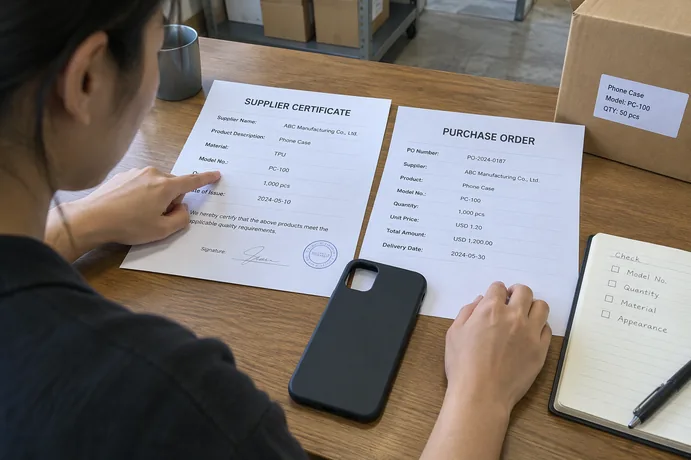
To compare tooling costs in phone case quotes, look at two things for each proposal: what the job costs at your planned order size, and what control the tooling charge gives you. A low tooling fee only helps if it covers the same work and gives you the access and reuse rights your project needs.

So keep the one-time tooling or development charge apart from the unit price. Match every quote to the same scope and quantity. Before you pick a proposal, get the ownership, access, maintenance, and reuse terms in writing.
Align the Phone Case Scope Before Comparing Prices
Two quotes can only be compared when they price the same case at the same quantity. Before you do any math, check that each phone case factory quoted the same phone model, construction, and customization, and the same tooling or development work.
Next, use one planned quantity for every proposal. Many quotes list prices by tier, so find out which unit price applies at your number. If one supplier quoted 1,000 units and another quoted 3,000, you are not comparing the same order yet.
When a quote lists tooling separately, work out a buyer-specific total:

Project total ($) = one-time tooling/development charge ($) + (quoted unit price in $ per unit × planned units) + confirmed applicable other charges ($)
Here is an illustrative example with made-up inputs. A $1,500 tooling charge plus $2.00 per unit × 2,000 units, with no extra fees, comes to $5,500 (or add any confirmed extra fees such as setup or testing). This is arithmetic on your own quote inputs. It does not tell you what a normal price is. Use only amounts the supplier has confirmed.
Bundled quotes need different handling. If a supplier confirms one combined project total that already includes tooling, compare that total at the same scope and quantity. Don’t add a separate tooling charge on top of it, because that counts the tooling twice. Don’t invent a split the supplier never gave you either. If you can’t tell whether tooling is included, ask for a written breakdown.
A simple worksheet keeps your assumptions visible:
| Quote item | Supplier A | Supplier B |
|---|---|---|
| Phone model, construction, customization | Record as quoted | Record as quoted |
| Stated tooling/development scope | Record or mark “unclear” | Record or mark “unclear” |
| Planned quantity and price tier | Your quantity, confirmed tier | Your quantity, confirmed tier |
| One-time tooling/development charge | Amount or “bundled” | Amount or “bundled” |
| Unit price at that tier | $ per unit | $ per unit |
| Other charges and exclusions | List them | List them |
| Project total | Calculated or confirmed combined | Calculated or confirmed combined |
Any row marked unclear or mismatched is a question for that supplier. It is not a number to guess.
Clarify What the Tooling or Development Charge Covers
Compare what each charge covers, not just its name or amount. Two line items both called “tooling” can cover very different work, so ask each phone case manufacturer to describe its charge in the quote or project documents.
Buyers can define tooling scope in detail in their own purchase terms. For example, AM General’s tooling terms from June 2016 define tooling for that company’s orders to include prototype and production tools, molds, software, accessories, and documentation such as engineering specifications and test reports. That is one buyer’s contract outside the phone case industry, not a rule for phone case suppliers. What it shows is that scope can be spelled out in writing, and your quote should do the same.
Ask each supplier to confirm:
-
Included items and deliverables: which molds, tools, or development work the charge pays for, and what you receive.
-
Prototype versus production scope: whether the charge covers samples, production tooling, or both, if the quote separates them.
-
Exclusions and separate charges: work that is billed separately or left out entirely.
-
Revision conditions: whether design changes after approval cost extra.
-
Document reference: which quote or project document records these answers.
If one supplier’s charge covers less work, add the cost of the missing items or ask for a revised quote before you compare totals.
Compare the Control Terms Before Choosing a Proposal
The fee alone does not tell you what control you get or who is responsible for what. Check each supplier’s written terms on four separate points. A clear answer on one point does not settle the others.
-
Ownership: Who owns the tooling, and when does ownership apply? For example, it might apply only after full payment. Don’t assume you own it just because you paid a fee.
-
Access: Can you inspect, retrieve, or transfer the tooling to another factory? Under what conditions, and at what cost?
-
Maintenance: Who maintains or repairs the tooling, and who pays for that work?
-
Reuse: Which future runs or products can use the tooling, and are there conditions or added charges? Only count reuse as a benefit when the terms define its scope.
For each point, mark every proposal as clear, missing, ambiguous, or different from the others. Arrangements differ between suppliers, and none of them is a universal default. This review is a practical buying step, not legal advice. Whether a term can be enforced depends on the law that governs that specific contract.
Then decide where each proposal stands:
-
Ready to compare: Product scope, charge coverage, quantity basis, and the key control terms are all clear.
-
Needs clarification: A bundled amount, price tier, exclusion, or control term is missing or vague. Ask the supplier to clarify it in writing.
-
On hold: A major scope or cost difference is still unresolved. Don’t choose this proposal yet.
If you would like to send us your project details for a quote laid out on these points, you can start from our store homepage.
FAQs
Is the quote with the lowest tooling fee the cheapest option?
Not necessarily. A low tooling fee can come with a higher unit price, a narrower scope, or fewer rights to reuse the tooling. Compare the project total at your planned quantity, then check what control each fee gives you.
What if a supplier won’t separate tooling from the unit price?
Compare the supplier’s confirmed combined total at the same scope and quantity. Ask in writing whether tooling is included and what it covers. Don’t estimate a split on your own.
Should I compare quotes from factories in different countries the same way?
Yes, the same method works. Contract terms may fall under different laws, though, so confirm which law governs each agreement before you rely on its ownership or access terms.
When should I ask again about control terms?
Ask again whenever the scope, quantity, design, or supplier changes. A change can affect which tooling is used and whether the earlier terms still apply.
Next step: price your order
Send your device list, target quantity, and any print or material requirements to our team. We will reply with tooling cost, MOQ, sampling time, and lead time for your exact build. Request a quote