For retail shelves, phone case packaging has to sell the product and identify it quickly. That means a clear phone model, the variant, what’s in the box, and whatever display and barcode details the buyer requires.
For ecommerce orders, the package has to get through a fulfillment center and a carrier network without damage. It also has to carry the right labels and pack efficiently.
Some brands can use one package for both routes. Many can’t. A good brief spells out what each route actually requires and doesn’t assume one box fits every channel.
Start With the Route and the Package Layer
Before you pick materials or artwork, name the two layers you might be specifying. The unit package holds the phone case as a retail product, while the outer shipper is any extra layer added so the order can travel as a parcel.
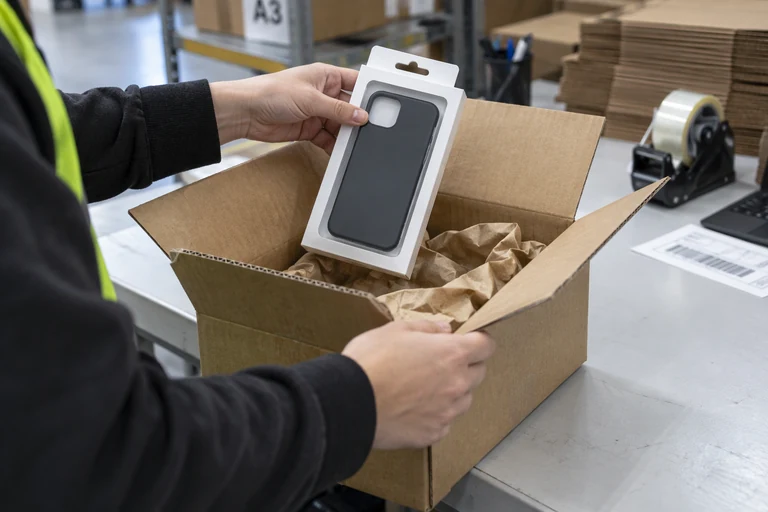
These layers do different jobs. A unit package built for a shelf may also ship, but don’t assume it’s ready to go out as a parcel. A peg-hook card that looks great in a store can scuff, bend, or leave no flat spot for a shipping label once it’s in a carrier’s network.
So start the brief by listing each SKU or configuration along with its sales channel, its fulfillment route (your own warehouse, a 3PL, or a marketplace fulfillment program), and its carrier. Every later decision depends on that map.
What to Specify for Retail Shelves
On a shelf, the package has a few seconds to tell a shopper “this fits your phone” and “this is the version you want.” Most of the specification below is design guidance. The binding parts come from each retail buyer.
Design recommendations to include in the brief:
- Compatible phone model, front and center. Make the exact model easy to read at shelf distance. Shoppers pick cases by device first.
- Variant details. Color, finish, and feature callouts (for example, a built-in stand or card slot) help a shopper tell similar SKUs apart.
- Package contents. Say what’s inside, such as the case alone or the case plus a screen protector.
- A defined identification area. Leave a clean zone suited to your package design for product identification, so artwork doesn’t crowd it later.
- Window or visible product, if it fits your brand. Seeing the case’s texture and color can help, but weigh it against protection and the display format.
Requirements to confirm with each retail buyer before artwork approval:
- The display format (pegboard, shelf, endcap, or another fixture) and any hang-hole or facing requirements.
- Package dimensions or size limits.
- Barcode type and placement.
- Any required labeling, warnings, or country-of-origin marking.
There’s no universal US retailer layout for phone case packaging, so ask for the target retailer’s packaging and item-identification specs in writing. Lock artwork only after you have them. One buyer’s barcode spot can clash with another’s hang-tab rules, and finding that out after printing gets expensive.
What to Specify for Ecommerce Orders
In ecommerce, the package has to protect the case through sorting and transit, carry the right labels, and pack quickly at the fulfillment station. Shelf appeal still counts at unboxing, but it isn’t the main job.
- Protection for the actual route. Decide whether the unit package can travel alone or needs an outer shipper. A rigid box with a snug fit may work alone on some routes. A thin card or blister may not. Don’t assume either answer for every phone case. Check it on your route.
- Limit movement inside the parcel. UPS packaging and label guidance recommends filling empty space with cushioning, such as bubble sheeting or kraft paper, so contents don’t shift. UPS presents this as general packing guidance, not a phone-case standard.
- A usable label area. Plan a flat surface for the outbound shipping label. UPS advises not placing the label on a seam, edge, closure, or on top of sealing tape. If you use a different carrier, check that carrier’s current instructions.
- Marketplace and fulfillment labels, checked separately. Unit labels and prep rules come from the marketplace or fulfillment provider, not the carrier. For example, under Amazon’s FBA barcode rules, a manufacturer barcode can be used only if the product meets Amazon’s eligibility conditions. These include new condition, a single scannable UPC, EAN, or ISBN matching one ASIN, and a brand enrolled in Brand Registry with the seller as a brand representative. Ineligible products need an Amazon barcode instead. If you choose Amazon barcode as your preference, Amazon requires an extra label on individual units, so leave room for it.
- Efficient outbound handling. Note how many steps it takes to pack one order. Every extra insert, wrap, or fold adds labor at volume.
Keep the Amazon example inside its scope. It applies to FBA, not to merchant-fulfilled orders or other marketplaces. Confirm prep rules for each fulfillment route before you lock the unit package or shipper.
Choose a Shared Package, an Ecommerce Shipper, or Channel Variants
Base the choice on verified route requirements and real pilot results, not habit. Work through these steps:
- Map every route. For each SKU, list the retail buyer, marketplace, fulfillment location or prep process, and carrier. Record each party’s requirements separately instead of blending them into one assumed standard.
- Compare candidate configurations. For each option, check buyer acceptance, label conflicts, protection needs, outbound packing steps, and packed dimensions and weight.
- Check packed dimensions, not just weight. According to UPS dimensional-weight guidance, UPS may bill by dimensional weight when a package is large compared with its actual weight. The formula is length × width × height in inches, divided by a divisor. The divisor depends on rate type: 139 for Daily Rates and 166 for Retail Rates. For example, a 10 × 8 × 4 inch shipper is 320 cubic inches. That works out to about 2.3 pounds at 139, which rounds up to 3 pounds. Confirm your own rate type before comparing options.
- Pick the configuration that fits:
- One shared package works when it meets verified retail requirements and handles the parcel route with no real label or handling problems.
- A shared unit package plus an ecommerce shipper works when the retail package is right for shelves but needs a separate layer for parcel protection or outbound labels.
- Channel-specific variants fit when verified buyer and fulfillment requirements conflict, or when trials show a shared setup fails one route.
- Pilot before you lock the spec. Ship test orders and check arrival condition, label scanning, packing time, and final packed dimensions. Then update the brief with what you learned.

When we help brands plan phone case packaging, we start with this route map, because it shows early whether a single package is realistic. You can reach our team through our store homepage.
FAQs
Can one phone case package work for both retail and ecommerce?
Sometimes. It works when the package meets every confirmed buyer requirement and also survives your parcel route with room for the needed labels. Pilot shipments are the most reliable way to confirm it.
Does a retail UPC cover Amazon FBA labeling?
Not automatically. Amazon lets you use a manufacturer barcode only for eligible products. Products that don’t qualify need an Amazon barcode, and choosing the Amazon barcode preference means adding a label to each unit.
Who sets the binding packaging requirements?
Each party sets its own. Retail buyers set display, barcode, and labeling specs. Marketplaces and fulfillment providers set unit-label and prep rules. Carriers publish packing and label guidance. Confirm each one for your actual route, and treat general design advice as a recommendation.
When is an outer shipper worth the extra cost?
Add one when the unit package can’t protect the case in transit or has no clean surface for shipping and fulfillment labels. Compare packed dimensions too, since a bulkier parcel may cost more on carriers that use dimensional weight.