A supplier video call works best when you use it to close specific gaps in your project record. Don’t treat it as proof that a factory can make your cases. Ask the supplier to link your exact custom phone case order to named people, named sites, and evidence you can check. Then write down what you actually saw, what you were only told, and what still needs follow-up.
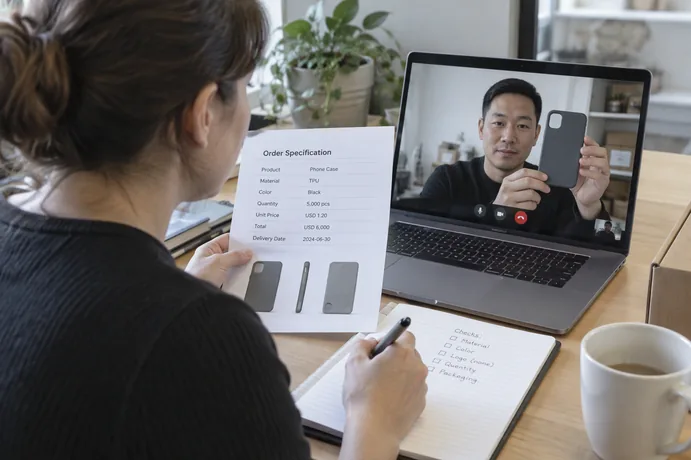
The questions below go in a set order. First you pin down the order itself. Then you find out who is responsible and where each step happens. After that, you sort live observations from claims, and you finish by assigning every open point to someone.

What a Supplier Video Call Needs to Cover
Send your agenda and specification before the call so the supplier can prepare order-specific answers. Keep your project record open while you talk and fill it in as you go.
Anchor the Call to the Exact Order
Start with your configuration. A factory tour or a capability slide tells you very little until it’s tied to the case you plan to buy.
- Specification: “Which drawing or specification revision are you working from? Can you show it on screen so we can confirm the revision matches ours?”
- Phone models: “Which phone model or models is this quote for? Are any models in our list outside what you’ve proposed?”
- Materials and finish: “What material, finish, and color are in your proposal? Is that exactly what’s in our spec, or a substitute?”
- Branding and packaging: “How will our logo or artwork be applied, and what packaging is included in this quote?”
- SKU mix and quantities: “Can you confirm the SKU breakdown and quantity per SKU you’ve quoted?”
- Schedule: “What schedule are you proposing for samples and production, and what does it depend on?”
- Scope boundaries: “Which steps will your company perform? Which are outside this proposal? Which will another company or site handle?”
If an answer drifts into general statements like “we make cases for many brands,” bring it back: “For our configuration, what does that mean?” A general capability claim doesn’t answer a question about your order.
Identify Who Owns Each Step and Where It Happens
Next, find out who is accountable. The person on the call may be a salesperson, an agent, or a trading company contact. They may not be the people who will run your job.
- Contracting party: “What is the legal business name that will sign the contract and issue invoices?”
- Named contacts: “Who is the project contact, the production contact, and the quality contact for this order? Can we have their names and direct contact details?”
- Change control: “Who approves changes to the specification or the production process? How will we be told about a change?”
- Escalation: “If a problem comes up, who handles it, and how fast do they respond?”
- Site mapping: “For each step, such as molding, printing, assembly, packing, and any subcontracted work, which named site does it, and at what address?”
- Subcontractors: “Which steps go to outside companies? Will you name them?”
It helps to build a simple map as you go:
| Step | Responsible company and site | Named owner |
|---|---|---|
| Case body production | ||
| Printing or branding | ||
| Packing | ||
| Quality checks |
Blank cells at the end of the call are your follow-up list. Don’t assume the location on screen is where your order will be made unless the supplier says so and you can confirm it later.
Separate What You Can See Live From What Needs Corroboration
This is where the call earns its value, and also where its limits show. A live display lets you see something at that moment. It doesn’t prove that a document is genuine, that a location belongs to your order, or that the supplier can produce your cases consistently at volume.
- Ask for live views: “Can you show the specification on screen, hold up a sample, or point the camera at the line you say will run our order?”
- Record only what was visible: Write “sample shown on camera, matte black, logo printed,” not “sample meets spec.” Note the date and time.
- Tie evidence to the order: For each important answer, ask, “What dated record or sample connects this to our order, our spec revision, and the responsible site?”
- Ask how you can check it later: “Can you send that record after the call? Can a sample matched to our spec be shipped to us?”
- Label unverified claims: Any answer without matching evidence is marked “unverified” in your record, no matter how confident the supplier sounded.
A simple three-column log keeps this honest:
| Topic | Observed on call | Status |
|---|---|---|
| Spec revision | Revision shown on screen | Needs written confirmation |
| Printing site | Only described verbally | Unverified |
| Sample | Shown on camera | Needs physical sample |
Turn Open Points Into Specific Follow-Ups
Close the call by turning every gap into a request with an owner and a date. “Send more info” isn’t a follow-up. “Send the site address for printing by Friday” is.
- Name the exact item: a document, a sample identified against your agreed spec, a written confirmation of a site or subcontractor, or an independent check.
- Assign an owner: name the person on the supplier side responsible for providing it, and the person on your side who will review it.
- Set a due date: agree on it before you hang up and repeat it in a written recap the same day.
- Keep claims open: a point stays unverified until you have received and reviewed the requested item.
- Add company-level checks where useful: for a foreign business partner, the U.S. International Trade Administration offers an International Company Profile service that provides basic or in-depth background check information on a specific foreign company, to help judge whether it suits you as a business partner. That is a check on the company. It doesn’t confirm that a particular factory can make your case.
Send your recap with the follow-up table attached and ask the supplier to confirm it in writing. That confirmation becomes the next version of your project record.
FAQs
How long should a supplier video call take?
There’s no fixed length. Plan enough time to go through your order details, the people and sites map, and the live checks without rushing. If key items stay open, schedule a second call instead of stretching the first one.
Can a video factory tour replace a sample or site check?
No. A tour shows you what was on camera at that moment. Use physical samples matched to your spec, written records, and independent checks to confirm what you saw and heard.
What if the supplier won’t name sites or subcontractors?
Mark those steps as unverified and make the names a written follow-up request with a due date. If the gap stays open, factor that into whether you move forward with this supplier.
Should I send my specification before the call?
Yes. Sharing the exact revision ahead of time lets the supplier prepare answers about your configuration instead of general capability, and you can confirm on screen that you’re both looking at the same revision.