
To qualify a phone case supplier for a new-phone launch, don’t just ask whether it is “ready.” Ask it to show a dated, documented path from your model and design inputs through tooling, samples, your approval, and the start of production. Then proceed, proceed with conditions, or hold, based on how complete and believable that path looks next to your target launch window.
This guide walks through that check one step at a time. Use the same steps for every candidate so you can compare their proposals side by side.
Set a Shared Model and Design Baseline
Start by giving every candidate the same launch brief. If each supplier works from different assumptions, their dates can’t be compared. The brief also shows which inputs are settled and which could still move.
A useful brief includes:
- Target phone model: name the exact model and variant the case is for.
- Design source and revision: list the design file or reference you are sending, with a revision number and date. In its PPAP (production part approval process) discussion, the DoD manufacturability guide notes that design documentation is used to confirm that the right part is ordered at the right revision level. A phone case program benefits from the same habit.
- Confirmed vs. pending inputs: mark each input, such as phone dimensions, button and camera cutouts, materials, finish, and any accessory compatibility, as confirmed or pending.
- Owner and decision date for each open item: state who will resolve it and when.
- Case requirements and launch window: state your key product requirements and the date you are planning toward.
- Reassessment triggers: ask each supplier which changes to an open input would force it to redo design, tooling, samples, or the schedule.
- Role map: note who owns each task on the supplier side and who approves on your side. ASQ’s summary describes the RASI model (Responsible, Approval, Support, Inform) as one tool for clarifying roles on product development teams.
This is a working brief you build yourself, not an industry standard checklist. Ask each supplier to list the assumptions behind its quote. That way, a later surprise can be traced back to a specific input.
Map the Dated Design, Tooling, and Production Path
Next, ask each candidate for its own milestone path instead of a single “ready by” date. Each milestone should be one event with its own date, owner, and proof that it is done. Relate program milestones to verifiable criteria and risk mitigation, as recommended in the DoD manufacturability guide.
Ask each supplier to:
- State its tooling route. Is it proposing new tooling, or reusing and validating existing tooling for this model? Ask what work and checks it thinks that route needs. Don’t assume the two routes follow the same schedule.
- List each design and tooling event. For each one, give the proposed date, the input it depends on, and the named owner.
- Define completion evidence. Say what you will receive to show the step is finished, such as an approved file, a trial result, or photos of parts.
- Flag dependencies. Mark every event that waits on you or an outside party, such as final model details or your sample approval.
- Define “production start.” Ask what the supplier means by it and which approvals and inputs it assumes will be complete by then.
These checkpoints match general development practice. An ASQ summary of a new-product-development paper lists supplier assessment and selection, preliminary model development, tooling capability trials, and launch planning among the critical activities. It also names documentation, communication, and well-defined roles as prerequisites. The paper does not set phone case lead times, so treat every supplier date as the supplier’s own estimate or commitment, not a guarantee.
Schedule Sample Review and Buyer Approval
Sending a sample and approving it are two separate events, and each one needs a date. Many timelines quietly assume you will approve the first sample right away. Make your own review time visible.
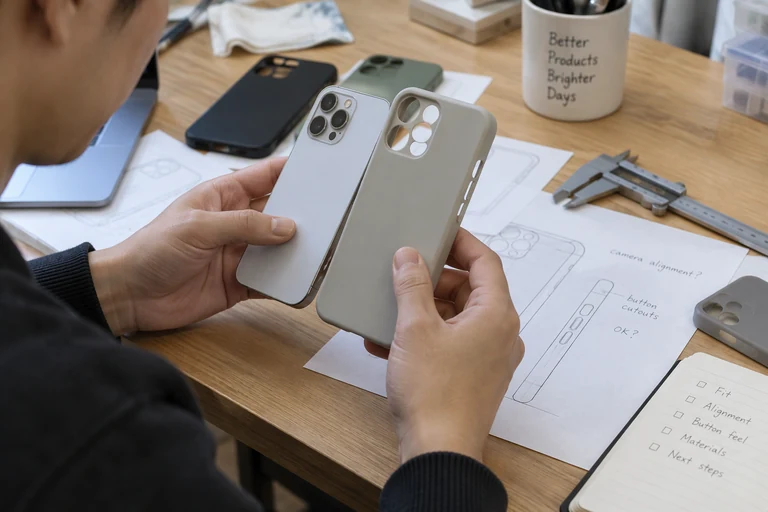
- Which sample, which revision: ask what sample and design revision you will be reviewing, and what that review is meant to confirm (fit, appearance, finish, or production readiness).
- Separate events: list sample dispatch, your review deadline, your approve-or-revise decision, and the supplier’s next dated action as four distinct entries.
- Named approver: put the name of the person on your team who approves, and their response date, on the schedule.
- Revision impact: ask how a requested revision would shift the next sample, the tooling work, and production start. Don’t assume a fixed number or length of sample rounds.
Formal approval steps are common in structured manufacturing. In its PPAP context, the DoD guide describes appearance approval and sample production parts being sent to the customer for approval. That is one example, not a phone case requirement.
Correction loops are real, too. In its own account of developing injection-molded Flipper Zero cases, the Flipper team describes successive testing iterations that fixed the part design, the molds, and the injection process. Fixes covered issues such as sink marks, surface waves, and a gap between case halves. That is one project, not a typical count, but it shows why a schedule should leave room for at least one correction and re-review.
Test Change and Slippage Response
Before you commit, see how a candidate documents a change or a missed date. Ask it to walk through a sample change using your launch brief. The goal is traceability, not proof that a recovery date will hold.
A good change or slip record should:
- Name the event. Identify the changed input or missed milestone, its current status, and the stated cause.
- Assign an owner. Name the person responsible for resolving it.
- Tie it to a revision. For a design change, record the new revision and your approval status. In PPAP guidance from the DoD manufacturability guide, engineering-change documentation usually includes a change notice approved by the customer’s engineering team.
- Show downstream effects. List which later milestones and approvals move, and their revised proposed dates.
- State the decision needed. Say what you must decide, and by when, to keep the revised path on track.
- Note mitigation. Describe any step that could reduce the delay, and its own risk.
If a candidate can only say “we’ll catch up,” it can’t show you what a slip does to your launch. That is a warning sign, even when its quoted lead time looks attractive.
Decide: Proceed, Proceed Conditionally, or Hold
Turn what you’ve gathered into one of three decisions. These are practical gates for buyers, not tested scores or delivery promises.

| Decision | When it fits | What to do next |
|---|---|---|
| Proceed | Inputs, milestone evidence, owners, and dependencies are clear, and the remaining path fits your window | Lock the brief revision and track each milestone against its evidence |
| Proceed conditionally | Some inputs or approvals are open, but each has an owner and decision date, and the path still looks plausible | Write down each condition and what happens if it slips; keep it open until evidence arrives |
| Hold | A key dependency, approval, tooling route, or slip impact is unresolved, so you can’t judge the path | Ask for the missing evidence, or compare other candidates first |
Base the decision on the specific gap, not on overall impressions. For example, a supplier with an undefined production-start point or no named approver for sample review usually belongs in “hold” until it fills that gap. If you’d like to talk through a launch brief with us, you can reach our team through our official store homepage.
FAQs
What should I send a phone case supplier before asking for launch dates?
Send the exact phone model, your design file with a revision number and date, a list of confirmed and pending inputs, an owner and decision date for each open item, and your target launch window. Send the same brief to every candidate.
Should magnetic or MagSafe-compatible features be part of supplier qualification?
Only if they are part of your product spec. If your case needs magnet compatibility, list it as a confirmed or pending input in the brief, and ask how it affects design, tooling, and sample review.
Is a supplier’s quoted lead time a guarantee?
No. Treat it as the supplier’s estimate or commitment. Judge it by the evidence behind each milestone, the dependencies it relies on, and how the supplier handles changes.
How many sample rounds should I plan for?
There is no standard number. Ask each candidate how a requested revision would change its next sample and production-start dates, and keep your own review time on the schedule.