To get quotes you can actually compare, give every supplier the same baseline case and order, then ask for each material or finish change as its own labeled, separately priced option. If you leave alternatives open-ended, each supplier fills the gaps differently, and you end up comparing different products at different scopes.
A well-built phone case RFQ does three jobs. It fixes everything you have already decided. It isolates the one thing that changes in each option. And it forces assumptions, substitutions, and missing prices into the open, so a blank line never passes for a match.
Set one shared baseline for every quote
Start by describing one reference case and one order that every supplier prices first, whether preparing your own spec sheet or consulting a custom case manufacturer. That baseline quote becomes your yardstick. Every alternative is then a measured step away from it, not a fresh guess.
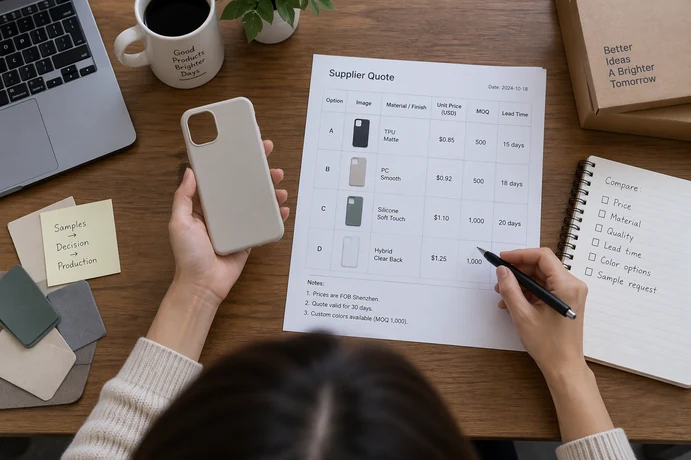
The two inputs that most often break comparisons are the device and the quantity. Name the exact phone model, not just the series, because one phone family can include several models with different sizes. State one order quantity, and if you want price breaks, list the same break points for every supplier. A quote at 1,000 units and another at 3,000 units cannot be compared line for line.
Beyond those two, build the baseline from the fields that apply to your project:
- Case design or reference: a drawing, a sample, or a reference style the supplier can quote against
- Artwork or branding: logo method, placement, and number of colors, if known
- Included components and packaging: what ships with each case and how it is packed
- Delivery destination: the city or port where you need goods delivered
- Currency: for example, US dollars for every line
- Requested timing: sample date and target ship date
Not every field will be settled. That is fine. Mark each one as decided, undecided, or not applicable, and put open questions in a separate list. Then suppliers know what you have fixed and what you are asking them to help define, and they are less likely to make silent assumptions.
Request each material or finish change as its own option
Turn your undecided choices into labeled option lines. If you are unsure about both material and finish, request a material-only change and a finish-only change separately so you can see the cost and feasibility impact of each on its own.
Add a combined option only when you actively want to evaluate that specific pairing, and label it as a distinct variation.
Ask each supplier to fill in a response table like this one:
| Field | What to ask the supplier for |
|---|---|
| Option label | Baseline, Option A (material only), Option B (finish only), Option C (combined, if wanted) |
| Proposed construction and finish | Supplier names the material construction and finish for this line |
| What changes and what stays fixed | The changed field, with all other baseline inputs confirmed unchanged |
| Feasibility and availability | Yes/no for this phone model and quantity, plus any conditions |
| Option price | Unit price on the shared quantity, currency, and delivery basis |
| Separate charges | Setup or tooling, samples, MOQ, shipping, and other fees, listed apart |
| Open items | Assumptions, substitutions, exclusions, and anything not quoted |
The table works because each row answers one question: same baseline plus one identified change, at what price, and with what caveats?

A few rules keep the responses honest:
- Let the supplier name the construction. Don’t fill in technical material details on the supplier’s behalf. If you write a guessed spec, a supplier may simply quote your guess.
- Ask for the basis of any claim. If a supplier says a material is more durable, slimmer, or equivalent to your baseline, ask for evidence about that specific case and material. Without it, treat the claim as unverified.
- Treat supplier suggestions as new lines. If a supplier proposes a different material, add it as a new labeled option. It should not quietly replace the line you asked for.
- Read blanks as unknowns. A blank cell, a substitution, or a note saying “equivalent” does not confirm that the option matches your baseline. Follow up on it.
- Keep extra charges out of the unit price. Ask for tooling, sample, and shipping costs as separate amounts so you can see whether a cheaper option only looks cheap because a cost was left out.
Compare aligned responses and confirm the selected specification
Only compare lines that share the same scope. Before looking at price, verify that each response matches your baseline phone model, quantity, inclusions, currency, and delivery terms.
If one supplier quoted a different quantity or left out packaging, ask for a revised quote or flag the mismatch in your comparison sheet rather than adjusting numbers by estimate.
For cross-border sourcing, a useful benchmark for a complete quote comes from ITA’s export-quotation guidance. In an export context, the International Trade Administration says a quotation describes the product, states its price, sets the time of shipment, and specifies the terms of sale and payment. Its list of details includes a price for each item and the total charges to be paid by the customer. That guidance is written for exporters in general, not for phone cases. Still, it supports asking for itemized option prices and a total cost rather than one blended number.
Once you choose a line, confirm it before production. We suggest this sequence as a buyer control, not a guarantee of quality:
- Agree on a sample or proof for the selected option, and on what it should show (material, finish, color, branding).
- Record any deviations between the sample and the quoted option, and decide whether to accept, correct, or requote.
- Freeze the written specification with a dated revision identifier, such as “Rev B, 2026-03-10,” and keep the supplier’s written confirmation with it.
- Reference that revision in your purchase order, so production is tied to the approved version.
Your next step is simple. Send the same RFQ and the same response table to every supplier. Chase any mismatched or unquoted fields, then approve one version in writing before production starts.
FAQs
Should I ask for material and finish changes in the same option?
Usually not at first. Separate material-only and finish-only lines show you what each change costs and whether it is feasible. Add a combined line only if you are seriously considering that pairing, and label it as its own option.
What if a supplier proposes a material I didn’t ask about?
Add it as a new labeled option and ask for the same fields: construction, feasibility, price, separate charges, and open items. Don’t let it replace a requested line, and ask for evidence behind any performance claim.
Do I need to fill in every baseline field before sending the RFQ?
No. Mark fields you haven’t decided as undecided or not applicable, and list your open questions separately. The key is to state the phone model and quantity the same way for every supplier.
How do I handle quotes that use different quantities or terms?
Don’t compare them directly. Ask the supplier to requote on your shared basis, or keep the mismatch visible in your comparison until it is resolved.