A phone case supplier certificate applies to your order only when four things match: the issuer is real and confirms the certificate is current, the named holder or site is the company and factory doing your work, and the stated scope covers the products or activities in your order. If any of these doesn’t match or can’t be confirmed, treat the certificate as not yet shown to apply. Good supplier certificate verification also means remembering that a certificate image, on its own, does not prove how a case performs or whether a factory can deliver your specific project.
This guide walks through the check, explains what different documents can and can’t support, and covers what to ask for when something doesn’t line up.
Check the certificate against the order
Before you open the file, decide what you want the document to prove. A certificate supports only its named subject and the requirements it lists, not every claim a supplier makes. Then work through these steps.
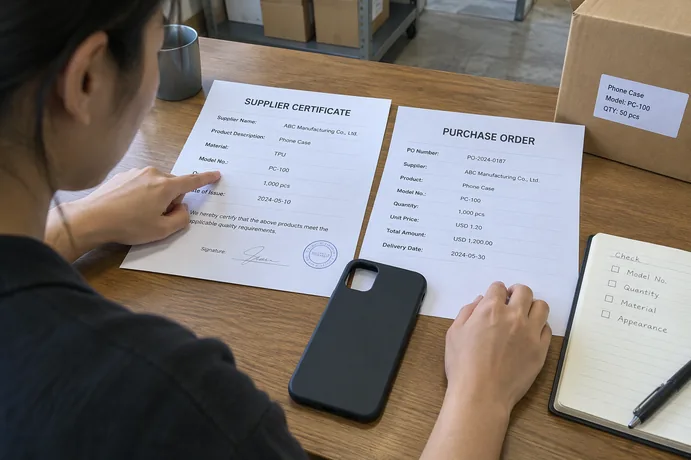
- Get the full document and name the claim. Ask for a complete, readable copy, not a cropped image or a logo on a sales deck. Write down what you want it to support, such as “this factory runs a certified quality management system.” If the copy leaves out the holder’s exact legal name or the address of the production site, ask for both.
- Confirm the issuer and current status. Find the certification body named on the document. Note that ISO itself does not issue certificates; outside certification bodies do. For accredited certification, ISO’s direct confirmation guidance says you can contact the relevant certification body, accreditation body, or Global ACI to confirm status. Ask the issuer whether the certificate number is valid and active today. A supplier-provided image is not confirmation of current status, and older pages may still point to the retired IAF CertSearch portal, so go straight to the issuer.
- Match the holder, site, and scope to your order. Compare the legal entity on the certificate with the company on your quote or contract. Then compare the listed site with the factory that will actually make your cases. Finally, read the scope statement and check whether it covers the work in your purchase order, for example molding, printing, or assembly of phone cases. A different trading company, affiliate, or factory is not covered unless the document or the issuer confirms it.
- Classify the result. Put each document in one of three groups:
- Matched: issuer confirms it is current, and the holder, site, and scope fit your order and claim.
- Not established: something is missing or unconfirmed, so you need more information.
- Outside scope: the document is valid but covers a different entity, site, or activity.
A mismatch is not proof of fraud. It also doesn’t show that the supplier can’t do the job. It simply means this document doesn’t answer your question yet.
| Check | What to compare | If it doesn’t match |
|---|---|---|
| Issuer and status | Issuer’s confirmation vs. the copy | Not established until confirmed |
| Holder | Legal name vs. your contract party | Ask how the parties are related |
| Site | Listed address vs. production factory | Ask for coverage of the real site |
| Scope | Scope text vs. ordered products or activities | Outside scope for this claim |

Separate certificates, test reports, and compliance documents
Different documents prove different things, so identify the type before you draw a conclusion. ISO defines certification as written assurance by an independent body that a specific product, service, or system meets specific requirements. That definition is general. It does not tell you that any certificate covers phone cases. What a certificate proves depends on the subject and requirements it names.
A management system certificate, such as one for a quality management system, speaks to how an organization runs its processes within the stated scope. It is not a test of a particular case model. It won’t tell you about drop protection, material makeup, or print durability for your design.
A product test report describes results for a specific sample, model, or component tested against stated methods. Read it for the sample description, model or part number, test methods, results, lab name, and date. A report on one material or one design doesn’t automatically carry over to a different design or a changed material.
Market compliance paperwork relates to a rule in a particular market. Check which requirement it cites, which product it names, and which market it covers. Don’t assume one rule applies to every phone case or every destination. Confirm the applicable requirement for your product and market on your own.
For any document, ask four questions: What was assessed or tested? Which product, model, or system is named? Which requirements are stated? Does it name the entity or site that matters for your order?
Choose the next evidence based on the gap
When a document doesn’t settle your question, ask for evidence that closes that exact gap. A broad “please send all your certificates” request rarely helps.
Status is unclear. Contact the issuing certification body or the relevant accreditation body to confirm the certificate is current, using the direct confirmation route ISO describes for accredited certification. Keep in mind that, per ISO, accreditation is not compulsory, and a non-accredited certification body is not necessarily disreputable. If your contract or customer requires accredited certification, though, hold to that requirement.
Holder or site doesn’t match. Ask the supplier to explain how the seller relates to the certificate holder and the factory. Request issuer confirmation or a current certificate naming the correct entity and production site.
Scope doesn’t cover the work. Ask for a document whose scope includes the products or processes in your order, or confirmation from the issuer that the activity is covered.
Your real question is product performance. A certificate won’t answer it. Request product- or component-specific test evidence tied to your model and materials. One example of what that looks like: in the context of US general-use (non-children’s) consumer products, CPSC’s component testing guidance says that when you rely on a supplier’s component testing, the supplier must give you copies of its test results or reasonable testing program, plus a written copy of that program for your records. This shows the kind of detail test evidence carries. It doesn’t mean that rule applies to every phone case.
Your real question is project capability. Ask for evidence tied to the proposed work, such as samples of your design, process details, or past output of similar products, instead of relying on the certificate.
Your next step is simple. Send one targeted request that names the unresolved detail: issuer status, certificate holder, production site, covered scope, product or model, test result, or capability evidence. When we receive a request like that, we can respond with the specific document or confirmation route that addresses it.
FAQs
Is a certificate image from a supplier enough to verify it?
No. An image can show what is claimed, but it doesn’t confirm the certificate is current. Confirm status with the issuing body. Even a confirmed certificate supports only its named subject and scope.
What if the certificate names a different company than my supplier?
Treat applicability as not established. Many suppliers work with affiliates or partner factories. Ask how the companies are related and get issuer confirmation or a document naming the entity and site that will make your order.
Does a quality management certificate prove the phone cases will perform well?
No. A management system certificate addresses how an organization runs its processes within its scope. For performance questions, ask for test reports covering your model, materials, or components.
Should I reject a supplier whose certification body isn’t accredited?
Not automatically. ISO notes accreditation isn’t compulsory and non-accreditation doesn’t necessarily mean a body isn’t reputable. Still check the issuer, and follow any accreditation requirement in your contract or customer specs.